
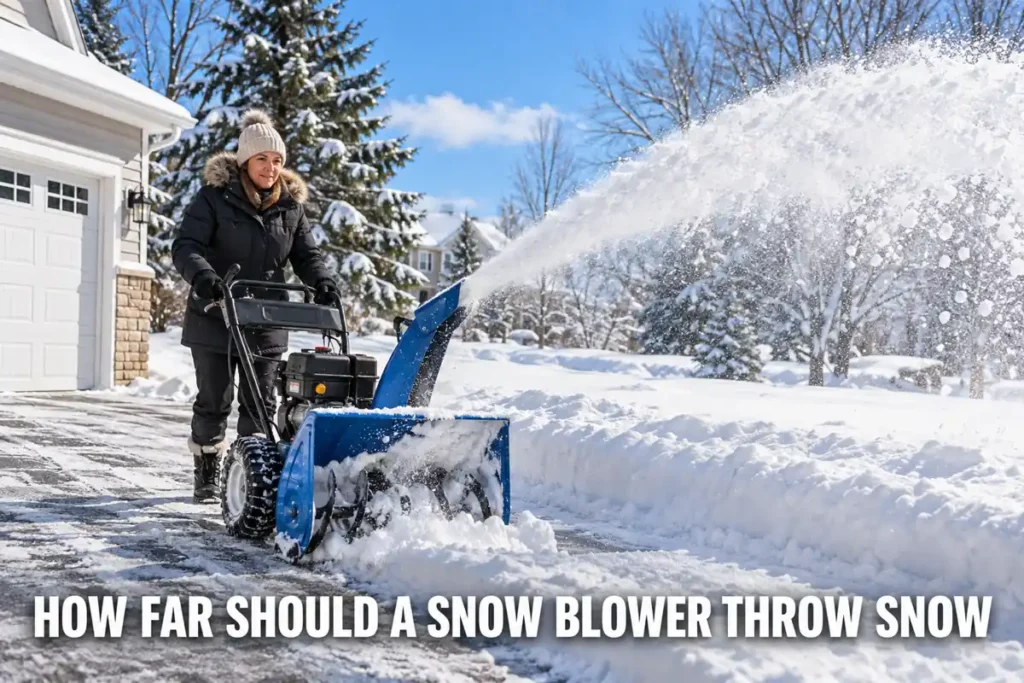
A snow blower should throw snow far enough to land it past the edge of the strip you clear, with room for the pile to keep growing. The maker’s “up to” figure is a best case, not a promise, so measure your own distance.
I walk the distance from the chute to my pile site before I trust any rating, because on my land the pile has to sit where the meltwater runs to the ditch. Below are the makers’ figures, the reach a driveway needs, and what takes feet off the throw.
How Far Should a Snow Blower Throw Snow? Past the Edge of Your Pile
Treat the maker’s number as a ceiling, and pick a machine whose figure sits well above the distance from your chute to the far edge of your pile. Toro’s own product page says throw distance “will vary with conditions”, and Ariens prints a range such as 3 to 50 feet for its Deluxe 24. I read “up to 45 feet” as the best day on the best snow, never as the plan. Three steps give you the number that matters:
- Pick the pile site first: open ground, a ditch edge or a hard shoulder, and never against a tree trunk, a drip line, a car or a door.
- Measure from the spot where the chute will sit to the near edge of that site, with a tape or by counting paces.
- Add the width of the pile itself, which the driveway section below shows how to work out, and compare the total with the maker’s figure for your machine type. Keep a clear margin.
Snow Blower Throw Distance by Machine Type
Every figure in the table is the maker’s “up to” best case, so read each one as a ceiling. No maker says which snow, auger speed or chute angle produced its number, which is why I never rank brands by these feet.
| Machine type | Maker’s figure, up to | Examples |
|---|---|---|
| Power shovel | 20 to 25 feet | EGO SNS1201: 25 feet. Toro 38361 (corded): 20 feet. |
| Single-stage | 30 to 45 feet | Cub Cadet class figure: 30 feet. EGO SNT2102: 35 feet. EGO SNT2134: 45 feet. |
| Two-stage | 40 to 60 feet | Cub Cadet class figure: 40 feet. Toro Power Max e26: 45 feet. EGO SNT2807: 60 feet. |
| Three-stage | 40 feet | Cub Cadet 3X 30 inch HD, with pitch control. |
Cub Cadet ties the figure to drive size. A big number buys fewer passes on a wide drive and nothing on a short path. On the 4-foot path to my house door the snow only has to land a few feet away, so even a power shovel’s 20 feet is more than the job needs. A close match for that job is covered in my comparison of the Snow Joe and WORX WG460 power shovels.
How Much Reach Your Driveway Needs
The reach you need is the distance the snow must cross to clear the strip plus the width of the pile it lands in. These numbers are my rule of thumb, not a standard. I assume the chute sits in the middle of the swath, a pass clears a swath about 2 feet wide (a 24 inch machine), the snow lands where I aim it, and the pile is a triangle 3 feet high, a height I picked, that holds exactly the snow I moved. The numbers below are worked examples under those assumptions, not minimums, so check them against your own pile site and route. The right size for your drive is in my page on the snow blower size you need.
Across the Drive
With passes beside the centerline thrown outward to each side, the chute sits about 1 foot off the centerline and the reach is about half the drive width minus 1 foot. Throwing across from the far edge, it is about the full width minus 1 foot.
| Drive width | Throw from the centerline, each side | Throw from one edge, across |
|---|---|---|
| 10 feet (one lane) | About 4 | About 9 |
| 16 feet | About 7 | About 15 |
| 20 feet (two cars) | About 9 | About 19 |
On the farm road I start at the shed and work outward, and I decide the throw side before the first pass.
Room for the Pile
For each foot of drive length, multiply the drive width by the snow depth to get the cleared area. The pile’s base is twice that area divided by the 3 foot height, and thrown to both sides each pile needs half of it.
| Drive width | Snow depth | All on one side | Split to both sides |
|---|---|---|---|
| 10 feet | 8 inches | About 4.4 | About 2.2 each |
| 20 feet | 8 inches | About 8.9 | About 4.4 each |
| 20 feet | 12 inches | About 13.3 | About 6.7 each |
Take a two-car drive, 20 feet wide, with 8 inches of snow, thrown from the far edge to one side. The stream must cross about 19 feet and the pile base adds about 9, so the farthest snow has to land about 28 feet from the chute in this example. An “up to 25 feet” power shovel falls short, but thrown to both sides from the centerline the same drive needs only about 13 feet. Drive width and method matter more than the maker’s number.
A pile I left close to the shed door melted toward the doorway on a warm day and froze across it at night, so I moved the pile to the ditch side, which meant a longer throw than I had planned for.
When the Pile Grows or a Plow Ridge Blocks the Gate
The pile grows through a storm, so the last passes must clear the top of the bank and need more pitch and reach than the first ones. A plow ridge at the end of a drive is a different job, so clear a couple of feet at a time, blow the snow into the yard, and repeat until the path is open. When a plow leaves a ridge across my gate, I take the top first and then the base. How deep a pass can go is the subject of my page on how much snow a snow blower can handle.
How Snow Type Changes the Throw
Snow type decides how much weight the machine moves with every foot it throws, and equal depths of snow can differ a lot in weight. Fresh snow in the mountains of Colorado and Wyoming ranged from 10 to 257 kilograms per cubic meter in density (1). The old 10-to-1 rule assumes about 100, and measured ratios of snow depth to water content run from about 3:1 to 100:1, where a lower ratio means denser snow (2).
Temperature plays a part. When the low-level air sat near or above about 27 F, the fluffiest snow, at ratios above 25:1, showed up less than 5 percent of the time, and in air colder than about 14 F, dense snow at ratios below 10:1 was rare (3). Snow days are few in some winters where I farm, but when snow comes it often falls near freezing, so I plan for the heavier case. My picks of snow blowers for heavy snow are the ones I plan around.
What Heavy Snow Does to the Stream
A heavy clump carries more momentum at the same exit speed, but the impeller has to move more mass every second. On a machine near its power limit the impeller slows, the stream thins, and the chute can plug. Toro’s manual lists “extremely heavy or wet snow” among the causes of poor discharge. Wet and slushy loads are the hard case, and I answer can a snow blower handle wet snow with what the manuals say.
Light powder behaves differently from machine to machine, and I judge it by watching where the stream lands on the first pass.
How Chute Pitch and Auger Speed Set the Reach
Two settings are in your hands: the angle of the stream and the speed it leaves the machine. The deflector, which Ariens calls the chute cap, is the flap on top of the chute that sets the angle, and the auger speed sets how hard the snow is flung. I explain the auger, impeller and chute in my guide to how a snow blower works.
Chute Pitch
According to EGO, the deflector handle sets the angle of the stream, “which determines the pitch of the discharge stream and, in part, the throwing distance”. On the Toro Power Max e26, pushing the Quick Stick forward lowers the deflector and pulling it rearward raises it.
In the ideal case, with no air drag and snow landing at the height it leaves, a 45 degree launch carries farthest. A lower deflector gives a flatter stream that lands sooner, and a higher one carries over a bank until a headwind pushes it back. So to make a snow blower throw snow farther, raise the deflector to clear a bank and lower it in a headwind.
Auger Speed and Exit Speed
Exit speed is how fast the snow leaves the chute, and according to EGO the auger speed lever on its two-stage blower “adjusts the auger speed which determines the throwing distance”. In the ideal case of no air drag, a 45 degree launch and equal heights, a clump needs an exit speed of about 21 mph to land 30 feet away, about 26 mph for 45 feet and about 30 mph for 60 feet. Air drag makes real speeds higher. When a machine throws well short of its figure, my checks for a snow blower not throwing snow far cover the causes I rule out first.
Range grows with the square of exit speed. In that ideal case a 10 percent drop in exit speed takes about 19 percent off the range, so keep the impeller at speed. The Toro Power Max e26 manual says to use its ECO mode, which lowers the rotor speed, “whenever you are moving light snow, or moving snow a short distance”. On a machine with such a mode I run full speed when the pile site is far and ECO when it is close.
What Wind, Pace and a Cold Battery Take Off the Throw
Wind, your walking speed and the battery take feet off the maker’s number. I watch where the first pass lands and adjust from there. I explain how packs, snow and cold affect how long a battery snow blower runs.
Wind and Pace
EGO says to “discharge snow in the same direction as the wind to prevent snow from being thrown back into your face”, and Toro says to discharge downwind whenever possible. A tailwind adds reach, and a headwind takes it away and returns the snow to you and to the strip you cleared.
Throwing into a Košava gust, the strong southeast wind that dominates our cold months, sent the snow back at me, so I turned the chute and changed the line of the pass. On open ground the wind that moves loose snow refills the strip I cleared, and snow thrown onto the windward side drifts back.
EGO says to slow down and narrow the swath to reduce the load on the battery, and Toro’s fix for weak discharge is a lower gear and less snow per swath. A slow, narrow pass keeps the impeller at speed. I rank the machines in my list of the best battery snow blowers.
Cold Packs
A review of lithium-ion batteries in cold weather found that low temperature reduces the available energy and raises the internal impedance (4), and lab tests on cells down to minus 4 F found substantially reduced energy and power (5). On a blower I read that as a pack that can leave the auger and impeller slower, and the maker ties auger speed to throw distance.
According to EGO, its blower may not start when the battery is at minus 4 F or colder, and the fix is to take the pack indoors and warm it for 10 minutes or more. I keep the spare pack indoors and swap it in when the first one goes cold.
Where the Snow and the Stones Go
A throw that reaches 40 feet carries whatever is in its path. Snow blowers can hurl small stones at high speeds, 30 feet or farther, so the distance that clears your drive also reaches windows, cars and people. Four habits cover most of the risk:
- Aim at open ground. Never point the discharge at people, pets, windows, cars or electrical devices.
- Clear the path first. EGO says the area must be free of stones, sticks, wires, gravel and other objects that could be thrown.
- Dress for it. Wear eye protection, gloves and non-slip boots, plus hearing protection from the first minute, plugs and earmuffs together on a gas engine, and as your machine’s manual says on a battery one.
- Run gas outdoors only. Never start or run a gas machine in a garage, even with the door open.
Gravel is a two-stage job: Toro, Greenworks and DeWalt say a single-stage is not for gravel, and the Toro and Ariens manuals have you lower the skid shoes so the scraper bar rises above the stones. Even then a stone can get thrown, so before the first pass on my gravel edge I walk the throw path and pull out stones and sticks. The full maker advice on a snow blower on gravel is in my page.
Clearing a Clogged Chute
Release the controls. Stop the engine and take out the key on a gas machine, unplug the cord on a corded one, or take out the start key, where the machine has one, and every battery pack on a battery one. Wait 10 seconds, as the EGO and Toro manuals say, until every moving part has stopped, then use the clean-out tool, or a stick if the kit has none. Never use a hand.
The hand is where the injuries are. In a US emergency room sample from 2009 to 2017, about 22 percent of hand injuries from reaching into a clogged snow blower were amputations, and most of the rest were fractures and lacerations (6). A packed chute has a handful of causes, and I sort them under why a snow blower keeps clogging.
Set the Reach for Your Drive, Then Aim the Chute
Three things carry this guide. The maker’s feet are a best case. The reach you need is the distance from your chute to the far edge of your pile. And wind, heavy snow, pace and a cold pack all take feet off without a number to warn you. I compare gas, battery and corded options in my list of the best snow blowers for 2026.
Before the season I pace out the distance from my chute spot to each pile site and write it down, so on the day the only job left is aiming. Then set the deflector for that morning’s wind. The throw a snow blower needs is the walk from your chute to the far edge of your pile, and the machine’s figure has to sit well above it. The pass patterns I walk are part of how I use a snow blower from the first storm to the last.
Frequently Asked Questions
How far does a snow blower throw snow?
A snow blower throws snow about 20 to 25 feet in a power shovel, 30 to 45 feet in a single-stage and 40 to 60 feet in a two-stage, going by the makers’ best-case ratings. Snow type, chute setting and wind take feet off those numbers.
How to make a snow blower throw snow farther?
A snow blower throws snow farther when the chute faces downwind, the deflector suits the bank or the headwind, and the auger runs at full speed. A slower pace and a narrower swath keep the impeller at speed.
How to make a single-stage snow blower throw further?
A single-stage snow blower throws further when you walk slower and take a narrower swath, because its auger both gathers and throws the snow. Set the deflector and chute for the wind, and take heavy snow in thinner layers.
Why does my snow blower not throw snow far?
A snow blower does not throw snow far when the pitch, the wind, the snow or your pace is working against the stream, and a cold or weak battery can slow the auger as well. If the stream stays weak with the chute set right and a light load, the Toro manual lists a loose or off drive belt and a plugged chute.
How much snow is enough to use a snow blower?
There is enough snow to use a snow blower once it is deeper than about 2 inches, because below that a shovel is quicker for me. Past that point the limit is your model’s rated snow depth, which differs between a power shovel, a single-stage and a two-stage.
References
- Judson A, Doesken N. Density of Freshly Fallen Snow in the Central Rocky Mountains. Bull Am Meteorol Soc. 2000;81(7):1577-1587.
- Roebber PJ, Bruening SL, Schultz DM, Cortinas JV Jr. Improving Snowfall Forecasting by Diagnosing Snow Density. Weather Forecast. 2003;18(2):264-287.
- Ware EC, Schultz DM, Brooks HE, Roebber PJ, Bruening SL. Improving Snowfall Forecasting by Accounting for the Climatological Variability of Snow Density. Weather Forecast. 2006;21(1):94-103.
- Jaguemont J, Boulon L, Dube Y. A comprehensive review of lithium-ion batteries used in hybrid and electric vehicles at cold temperatures. Appl Energy. 2016;164:99-114.
- Ji Y, Zhang Y, Wang C-Y. Li-Ion Cell Operation at Low Temperatures. J Electrochem Soc. 2013;160(4):A636-A649.
- Hammig B, Jones C. Hand injuries associated with reaching into a snow blower to clear clogged snow. Am J Emerg Med. 2020;38(4):785-788.
Safety Note: Snow blowers throw snow, ice and hidden objects with force. Never reach into a clogged chute or auger. Shut the machine off first: stop the engine on a gas model, unplug a corded model, or remove the safety key and every battery pack from a battery model. Wait at least as long as your manual says, often 10 seconds, and until every moving part has stopped, then remove the key and disconnect the spark plug wire where your manual says so, and clear the clog with the clearing tool. Keep people and pets out of the discharge path, run gas models outdoors only, and read the manufacturer’s manual.