
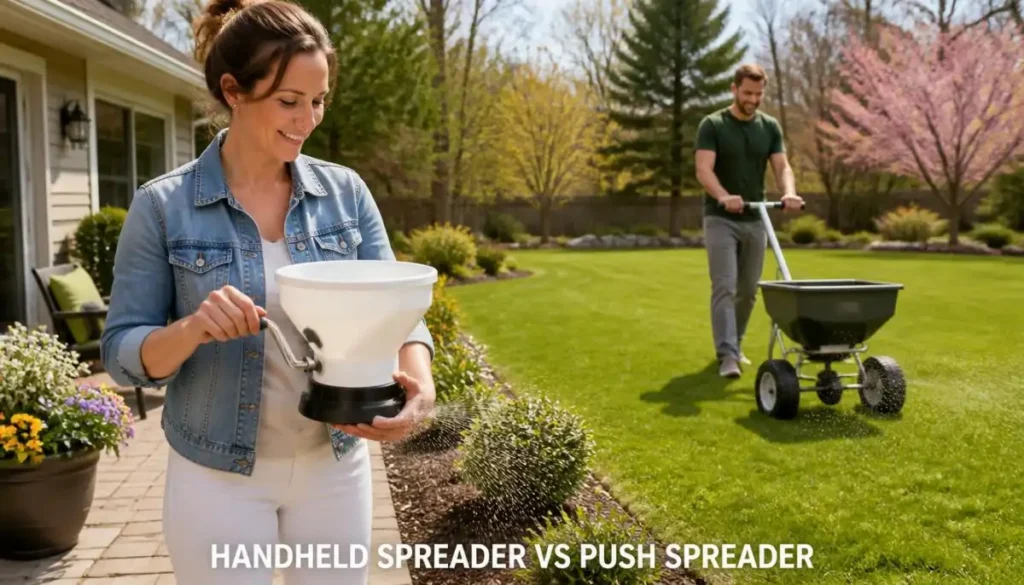
In the handheld spreader vs push spreader choice, the first difference is who turns the plate: your hand on a handheld, the wheels on a push spreader. That one fact changes how you carry, fill, steer and clean each one. In large-scale production I verified seed drill calibration on weighing trays, so I read every spreader by what drives its plate and what that asks of the person using it. Below I compare drive, hopper size, filling, controls, care and the jobs each form suits, using the figures makers print for named models.
Handheld Spreader vs Push Spreader: The Short Answer
A handheld spreader is the form you carry. You hold its hopper in one hand or hang it from a strap, and you turn a crank to spin the plate. A push spreader is the form you walk behind. It rolls on wheels, and the wheels drive the plate. I explain the parts and the kinds in my handheld spreader explainer.
I recommend a handheld spreader for beds, edges and small plots. For long strips and open ground, I recommend a push spreader. The choice follows the job and the hopper size the maker prints, and the product label and your manual decide how either one is used. Push drop spreaders also exist; they release product through openings and have no throwing plate, so they sit outside the plate comparison below. Battery handhelds have a motor, so I discuss them in my battery powered versus handheld spreader comparison; this page covers hand-crank handhelds and unpowered walk-behind push spreaders.
- Plate drive: a handheld turns by your crank, and a push spreader turns by its wheels.
- Carry: a handheld hangs from your hand or shoulder, and a push spreader’s wheels carry the load.
- Hopper: makers print pounds for some models and nothing comparable for others, so compare only like figures.
- Controls: a handheld has a trigger, knob or lever on the unit, and a push spreader has a lever or trigger on the handle.
- Care: both are stored empty, clean and dry, and a push spreader also has a gearbox, an axle and wheels that its manual covers.
How Each Spreader Turns the Plate
A handheld crank spreader and the push broadcast spreader this page uses as its example both throw product with a spinning plate, so the speed of that plate matters. What differs is who sets it, and that decides what you must keep steady. My guide on how a broadcast spreader works follows the product from hopper to throw.
How a Handheld Gets Its Plate Speed
On a handheld broadcast spreader, the plate speed follows your crank. According to SOLO’s manual, edition 10/2000, each full turn of the crank handle turns the impeller a set number of times, so a slower or faster crank changes the plate speed directly. Scotts’ placard for the Whirl says that application rates “may vary depending on crank and walking speed.”
How you carry it matters too. In a small study of a hand-operated spinner spreader, the widest swath and the most uniform spread came with the spinner carried directly in front of the operator and the crank slightly to the right, and the best coverage came from walking the perimeter so that each pass overlapped the previous one (1). It was one old study on one design, so I take it as a reason to keep your carry steady and not as a rule for your yard.
How a Push Spreader Gets Its Plate Speed
On a push broadcast spreader, the wheels turn the plate. EarthWay’s manual for the 2600A-Plus describes a gearbox on the axle that drives the impeller, and NC State Extension says that generally only one wheel drives the impeller (2). The plate speed therefore follows how fast you walk, and a spreader that keeps spreading through a turn changes its plate speed and its pattern. I describe the plate itself in my spreader impeller guide.
Pace matters on both forms. A laboratory test of one rotary turf spreader found that its application rate changed with travel speed (3). NC State advises you to start walking and reach your calibrated pace before you open the lever, and to close the lever before slowing, turning or stopping (4). I recommend one steady pace for every pass, because NC State says to calibrate for each product and for each person using the spreader (2).
Hopper Capacity and Weight as Makers Print Them
Hopper size sets how often you stop to refill, so it is the figure I read first. Makers print it in different ways, and I compare only figures on the same basis. The hopper has its own page, my spreader hopper guide, with the parts, materials and care.
| Model | Form | Hopper capacity, maker’s figure | Weight, maker’s figure |
|---|---|---|---|
| Brinly HHS3-5BH | Handheld, hand crank | 5 lb, or .5 gal (2 L) | Not listed |
| SOLO 421 | Chest-mount, hand crank | 20 lb | 5.5 lb, empty |
| EarthWay 2600A-Plus | Push, broadcast | 40 lb | Not listed |
| Scotts Whirl | Handheld, hand crank | Not listed in pounds | Not listed |
| Scotts EdgeGuard DLX | Push, broadcast | Not listed in pounds | Not listed |
Scotts does not print a pound figure for the Whirl or the EdgeGuard DLX, so the table cannot size them against the others. SOLO’s manual gives its 5.5 lb weight for the empty unit.
A smaller hopper means more fills for the same job, whether it sits on a handheld fertilizer spreader or a push fertilizer spreader. How many fills a job takes depends on the amount the product label gives, so I never guess it from the hopper alone. Brinly says the variable flow of the HHS3-5BH spreads material up to 5 feet, which is a ceiling for that model and not a result for your yard. I set the printed figures of two handhelds side by side in my Whirl against Brinly handheld spreader comparison.
Filling Either Spreader Safely
Filling is the first hands-on job, and it puts product and moving parts close to your hands. Complete the box below before you fill, clear a clog or clean either spreader, and come back to it whenever a later step points to it. A battery handheld follows its own manual for the battery.
Safe-State Box
Stop and make safe before you fill or unload the hopper, reach into the hopper, clear a clog, clean or rinse the spreader, lubricate it, adjust the gate or the pattern, change a part, hitch or unhitch it, charge or change a battery, move it, store it or leave it. Keep your hands, feet, hair and loose clothing away from the impeller, the plate, the agitator, the gears and the wheels while anything can turn. During normal spreading, walk or drive only as your manual and the product label permit; walking behind a push spreader, or pulling a tow-behind unit at the speed its manual describes, is operation, not transport. Walk-behind or hand-crank spreader: close the gate, then stop walking or cranking, and wait until the impeller, plate, agitator and wheels have stopped turning. Keep the gate closed while you fill. Wear all the protective equipment the product label and your manual require while you fill, clean or clear a jam. Clear a clog only with the method in your exact manual. Follow every applicable safety step in your manual, in the order it specifies. Refit every guard and cover, and check that the gate opens and closes before product goes back in.
Read the Label and Wear the Gear
Read the product label before you open the bag. Follow its directions for the permitted use, the application amount, protective equipment, weather, watering in, access by people and pets, storage and disposal. Using a registered pesticide in a way its label does not allow is against federal law. Follow the spreader’s manual too. If the product’s instructions and the spreader’s instructions cannot both be followed, do not use that combination; ask the manufacturers for guidance.
Wear all the protective equipment the product label and your spreader’s manual require, and put it on before you open the bag. Wear it every time you fill the hopper, clean the spreader or clear a clog. Protective equipment lowers your exposure; it does not make handling a lawn product safe.
SOLO’s manual for the 421, edition 10/2000, adds its own list: wear safety glasses or eye shields, closed-toe shoes with good traction, snug long-sleeved clothes, tightly cuffed or cuffless pants and non-slip gloves, and tie long hair back and keep it away from the spreader. It also says to wear a respirator if appropriate for the type of material being spread, and, when spreading chemicals, to wear protective clothing, a respirator and eye protection.
The product label gives the application directions, so read it before you set the gate. A setting listed for your exact spreader and product is a starting point, not proof of the amount delivered: follow the spreader’s manual and calibrate for the product, the spreader and the person using it before you apply. Never exceed the label’s application rate.
Fill, Spills and Runoff
Before you fill or unload the hopper, complete the stop and make-safe steps for your spreader in the safe-state box, and keep the gate closed. For fertilizer, fill on a hard surface where spilled granules can be swept up, away from drains and water. Follow the product label’s handling and ventilation directions, and wear all the protective equipment the label and your manual require. Fill only to the level your manual allows, and secure the hopper cover or lid if your spreader has one. Keep children and pets away, and never leave a filled spreader where they can reach it.
SOLO’s manual adds one rule for its handheld: it says not to load the hopper while carrying the spreader: move the flow rate lever to zero, set the 421 on a flat surface, remove the lid, fill, and replace the lid. I recommend the same habit for every handheld, which is to set it down before it is filled. Scotts’ placard for the Whirl says to fill over pavement so spilled product can be swept up, and Scotts’ sheet for the EdgeGuard DLX says to fill over the driveway and clean up any product that spills.
Keep people and pets away from a spill. Follow the product label and its safety data sheet for collecting, reusing and disposing of spilled product, and wear the protective equipment they require. Never hose or wash granules into a street, a gutter, a drain, a ditch or water, and do not pile spilled product onto the lawn or return contaminated material to the bag. If you cannot manage the spill safely, stay away and call the emergency number on the label. Call Poison Control at 1-800-222-1222 if anyone is exposed, and call 911 for a fire or immediate danger.
Keep fertilizer off pavement and out of drains and surface water. If scattered plain fertilizer lands on a sidewalk, a driveway or a patio, sweep it back onto the lawn before you water, without going over the label rate; collect a concentrated spill instead. For pesticide granules, follow the label’s cleanup instructions. Follow any buffer requirement that applies and keep fertilizer out of those areas. EPA advises against fertilizing before windy or rainy days, and Purdue advises against fertilizing drought-stressed, dormant or frozen turf. Follow the product’s weather and watering directions too. Purdue Extension gives the same sweep-back advice for granules that land on a driveway, sidewalk or patio (5).
Children, Pets and Exposure
Keep children, pets and other people away from the area while you fill and spread, and keep them off the treated area for as long as the label says. Store the bag and the filled spreader where they cannot reach them.
If someone swallows or is exposed to a lawn product, follow the first-aid section of the product label and call Poison Control at 1-800-222-1222, and keep the product label with you. Call 911 in an emergency.
If the product in the hopper contains a pesticide, such as a weed-control granule, one more rule applies. Wash your hands before eating, drinking, smoking or using the restroom when you work with pesticides. Change your clothes and wash your hands immediately after you apply a product that contains a pesticide, and follow the label’s additional washing and clothing instructions.
Controls, Turns and Stops on Each Form
The controls differ more than the plates do, because a handheld puts them on a small body in your hands and a push spreader puts them on a handle.
Brinly’s HHS3-5BH has a knob that adjusts the gate and a trigger handle. Scotts’ Whirl opens its gate with a trigger while you turn the crank. SOLO’s 421 has a flow rate lever that you work with the left hand while the right hand turns the crank. On the EarthWay 2600A-Plus, a lever on the T-handle opens the flow holes while you push, and its manual says to push the lever forward to close them before you stop moving. Scotts’ guide for the EdgeGuard DLX has you squeeze the trigger on the handle to release product and release it when making turns. I discuss the hand-powered model’s specifications and limits in my review of the Scotts Whirl.
Close the gate before you stop, before you slow down to turn, and whenever you pause, and open it again only after you are walking or driving at the steady pace your manual describes. Do not spread while you turn.
Level Plate and Wind
Hold a push spreader’s handle at the height you calibrated at and keep the plate level. NC State Extension says to hold the handle at the same height used in calibration, to keep the impeller level and to push the spreader and not pull it (2). A study of tractor-mounted rotary spreaders found that tilting the spreader from side to side changed the pattern (6); I take the principle, not the angles.
Wind and damp air change the throw. SOLO’s manual advises you to plan the work so the wind is behind you if possible. NC State adds that wind, slope, temperature and humidity affect distribution, and that you should delay application when conditions interfere (2). A laboratory study found that humid air and product buildup on the impeller can shift a rotary spreader’s pattern (7). I show what skews a throw in my guide to the pattern of a broadcast spreader.
Jams and Clogs
Never push, kick or dig product out of the gate or off the plate while anything can turn. If product clumps or bridges in the hopper or the gate clogs, stop and complete the stop and make-safe steps in the safe-state box first, then clear it only with the method in your manual. NC State advises keeping the material dry to prevent caking and clogged ports (2). EarthWay’s manual for the 2600A-Plus says not to use powdered materials, because they will damage the gearbox.
Assembly, Cleaning and Storage for Each Form
Each form asks for a different amount of work before the first fill and after the last one, and the manuals differ from model to model.
Assembly
SOLO’s 421 arrives with the crank handle and the cross-shoulder strap inside the hopper, so you fit both and set the strap height before the first use. EarthWay’s 2600A-Plus comes unassembled, and its manual has 16 steps. Scotts’ guide for the EdgeGuard DLX has one: raise the top half of the handle and tighten the wing nuts by hand. According to Scotts, the Whirl comes fully assembled. Once a spreader has held product, complete the stop and make-safe steps for your spreader in the safe-state box above before you change a part. The handle and trigger get a closer look in my review of the EdgeGuard DLX.
Cleaning
Before you clean the spreader, complete the stop and make-safe steps in the safe-state box, and wear the protective equipment the product label and your manual require. Handle leftover product, cleaning water and residues as the product label directs. Clean the spreader only by a method both the label and the manual permit, and rinse it only where they permit it, keeping product and contaminated wash water out of drains and water supplies. Dry the spreader completely, and lubricate it as its manual directs. If you change products, follow both products’ cleaning requirements: a rinse alone does not show that all residue is gone.
SOLO’s manual says to clean the whole unit with soap and water, dry it and store it. EarthWay’s manual says to empty the hopper, rinse the spreader and coat the metal parts with a light oil, and it adds that the gearbox is sealed and factory lubricated and should not be opened. Those are two makers’ lines for two models, so follow the manual of your own. NC State says to wash a spreader, dry it completely to prevent rust, and lubricate it as the owner’s manual specifies (2). My full SOLO 421 spreader review covers the strap and the hopper in more detail.
Storage
Before you store the spreader, complete the stop and make-safe steps in the safe-state box. Store it empty, clean and dry, as your manual describes, with the gate closed. Keep products in their original labeled containers, securely closed, under the storage conditions their labels give, and away from children and pets. Lock pesticides away, apart from fertilizer, food and animal feed, and never put any product into a food or drink container. Store a battery as the battery manual describes.
A handheld hangs on a hook or sits on a shelf. A push spreader needs floor space for its frame, handle and wheels. The frame, the wheels and the plate are laid out in my guide to what a push spreader is.
Which Jobs Suit Each Spreader
The job decides the form, and neither form wins every job. What follows is how I match the two to the ground I work. When you want a shortlist across both forms, my best lawn spreader picks sort them by hopper and gate.
Beds, Edges and Small Plots
A handheld lawn spreader goes wherever you can walk. Picture a vegetable plot of beds with packed-soil paths between them. I recommend one of my best handheld spreader picks for a plot like it, because there is no wheeled frame to steer between the beds. SOLO says its 421 is made for irregular terrain, more conveniently than a wheeled spreader, and that is the maker’s claim.
Carrying a loaded hopper tires your arm and shoulder. When your arm or shoulder tires, stop and rest before you carry on, and never adjust the strap and keep going.
Long Strips and Open Ground
On a long strip, such as the cover-crop alleys between my orchard rows, I recommend a push lawn spreader, because its wheels carry the loaded hopper and you only steer. EarthWay prints 40 lb for the 2600A-Plus hopper and Brinly prints 5 lb for the HHS3-5BH. How often you refill depends on the product, the fill level your manual allows and the amount the label requires. I look at that model in detail in my review of the EarthWay 2600A-Plus.
When a Job Outgrows a Handheld
When you refill many times, or your arm tires before the hopper empties, the job has outgrown a handheld, and a push spreader is the next form. My best push spreader picks cover the push models I would start with.
That is a sizing point only. Where the product label or the spreader’s manual forbids a use, no spreader is the answer, and a bigger one is never a workaround.
Choosing Between a Handheld and a Push Spreader
Three points matter most. Your crank turns the plate on a handheld and the wheels turn it on a push spreader, so a steady pace matters on both. Compare only hopper figures that makers print on the same basis. The label and the manual decide the product, the setting and the steps. My tip is to put the bag’s label and the manual side by side before the first fill and read them together. A handheld spreader vs push spreader choice comes down to the job in front of you: carry one for beds and edges, and push one for long strips. I put the two forms head to head on one pair in my EdgeGuard against Whirl comparison.
Frequently Asked Questions
What is the difference between a handheld spreader and a push spreader?
The difference between a handheld spreader and a push spreader is how it is carried and how the plate is driven: you carry a handheld and turn its plate with a crank, and a push spreader rolls on wheels that drive the plate as you walk. Makers print hopper sizes for some models, such as 5 lb for the Brinly HHS3-5BH and 40 lb for the EarthWay 2600A-Plus. Read your own manual for the controls and the care steps.
Is a handheld spreader better than a push spreader?
Neither a handheld spreader nor a push spreader is better in every job: a handheld suits beds, edges and small plots because you carry it anywhere you can walk, and a push spreader suits long strips because its wheels carry the load. The product label and your manual decide how either one is used.
Can you spread grass seed with a handheld spreader?
You can spread grass seed with a handheld spreader when its maker names seed for that model and the seed label allows it: Brinly lists grass seed for the HHS3-5BH, and SOLO’s manual names seed among the materials for the 421. The label and the manual decide the setting and the amount. Before you fill, complete the stop and make-safe steps for your spreader in the safe-state box above.
Can I spread fertilizer with a hand spreader?
You can spread fertilizer with a hand spreader, meaning a handheld crank model, when its maker lists fertilizer for that model and the product label allows it: Brinly lists fertilizer for the HHS3-5BH, and SOLO’s manual names fertilizers for the 421. The fertilizer label gives the application directions, and the spreader maker’s chart is only a starting point for the setting. Before you fill, complete the stop and make-safe steps for your spreader in the safe-state box above.
Which is easier to store, a handheld spreader or a push spreader?
A handheld spreader is the easier of the two to store, because it has no frame, handle or wheels to fit into the space. Both are stored empty, clean and dry, as the manual describes. Before you store either one, complete the stop and make-safe steps for your spreader in the safe-state box above.
References
- Wolf DD, Smith ES. Uniformity of seed and fertilizer distribution with a hand-operated spinning spreader. Trans ASAE. 1979;22(4):761-762.
- Miller G, Kerns JP, Billeisen T. Organic Lawn Care: Composting and Spreaders. AG-562. NC State Extension; 2026.
- Parish RL. The effect of speed on performance of a rotary spreader for turf. Appl Eng Agric. 1987;3(1):17-19.
- Buhler W, Erickson E, Bruneau A, et al. The Calibration of Turfgrass Boom Sprayers and Spreaders. AG-628. North Carolina Cooperative Extension; 2001, reviewed 2024.
- Bigelow CA, Tudor WT, Nemitz JR. Facts About Phosphorus and Lawns. AY-334. Purdue University Extension.
- Yildirim Y. Effect of side to side spreader angle on pattern uniformity in single- and twin-disc rotary fertilizer spreaders. Appl Eng Agric. 2008;24(2):173-179.
- Parish RL. The effect of relative humidity on rotary turf spreader patterns. Appl Eng Agric. 1991;7(5):541-544.
Safety Note: Read the product label and your spreader’s manual before handling product. Follow both; if their instructions cannot both be met, do not use that combination. Registered pesticide use must comply with its labeling. A listed spreader setting is a starting point; calibrate as the manual directs and never exceed the label rate. Wear all protective equipment required by the label and manual before opening the container and during filling, cleanup and jam clearing. Wash your hands before eating, drinking, smoking or using the restroom when working with pesticides. After application, change your clothes and wash your hands immediately, and follow the label’s additional washing and clothing instructions. Keep children, pets and other people away during handling and application and off treated areas for as long as the label requires. Emergency first: if a battery becomes unusually hot, swells, hisses, smells unusual or smokes, stop using the spreader without handling or removing the battery. Keep people away and follow the battery manual’s emergency instructions. If it smokes, burns or presents immediate danger, move away and call 911 or the fire department. Otherwise, complete the applicable stop and make-safe sequence before filling, unloading, reaching into the hopper, clearing a jam, cleaning, lubricating, adjusting, changing parts or batteries, hitching, unhitching, transporting, storing or leaving the spreader. Walk-behind or hand-crank: close the gate, stop walking or cranking, and wait for all moving parts to stop. Tow-behind: close the gate, stop the vehicle, set the parking brake, switch off the engine and remove the key as the vehicle manual directs, and wait for the wheels, impeller and agitator to stop before reaching into the hopper or touching the impeller. Battery spreader: release the trigger or close the gate, switch off, wait for moving parts to stop, then remove the battery as the manual directs and keep it away while working. Follow any additional isolation steps in the exact manual. Keep hands, feet, hair and loose clothing away from moving parts. Clear jams only by the manual’s method. Refit guards and covers and check the gate before refilling. With the spreader made safe and the gate closed, fill fertilizer on a hard surface where spills can be collected, away from drains and water. Follow the label’s handling and ventilation directions and the manual’s fill limit. Keep people and pets away from spills. Follow the label and safety data sheet for collection, reuse and disposal; do not spread concentrated spills onto the lawn or return contaminated product to its bag. Sweep scattered plain fertilizer from pavement onto the intended lawn before watering only without exceeding the label rate. Follow the label’s cleanup instructions for pesticide granules. Never wash product into streets, gutters, drains, ditches or water. Observe applicable buffers. EPA advises against fertilizing before windy or rainy days; Purdue advises against fertilizing drought-stressed, dormant or frozen turf. Close the gate before stopping or turning, as the manual directs. Follow both towing manuals for hitching, turning, slopes, speed and load limits; never ride on the spreader or carry passengers on it. Use only batteries specified for the model. Recharge rechargeable batteries only with a charger approved for them, as the manual directs; never recharge disposable cells. After completing the applicable shutdown, handle leftover product, cleaning water and residues according to the product label. Clean only by methods permitted by both label and manual, keeping contaminated water out of drains and water supplies. Rinse only if permitted, then dry and lubricate as directed. A rinse does not establish that all pesticide residue is gone. Use salt or ice melt only when the product directions and spreader manual permit it. Salt-based deicers can damage metal; follow the model’s cleaning instructions. Do not use lawn fertilizer to melt ice. Store the spreader empty, clean and dry as its manual directs. Keep products securely closed in their original labeled containers under their labels’ storage conditions, away from children and pets. Lock pesticides away, separate from fertilizer, food and feed; never use food or drink containers. For human exposure, follow the label’s first-aid instructions, call Poison Control at 1-800-222-1222 and keep the label available. Call 911 for immediate danger.