
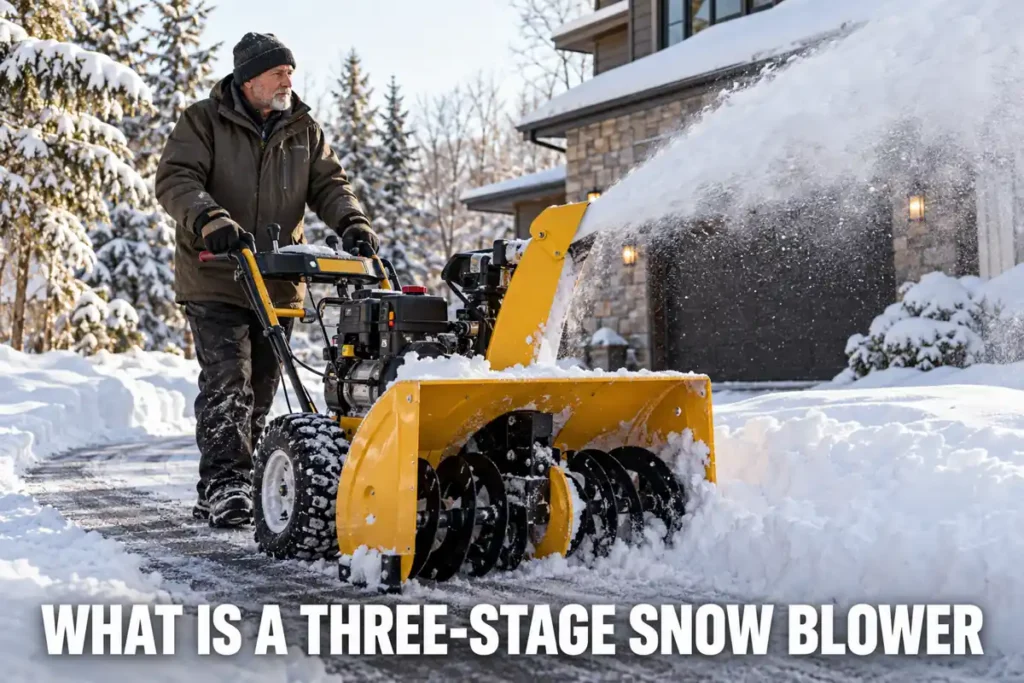
A three-stage snow blower is a gas, walk-behind machine with one extra spinning part, a steel accelerator between the augers and the impeller. The augers break up the snow and draw it in, the accelerator pulls it through, and the impeller throws it out of the chute.
I farm in northern Serbia, where snow often falls near freezing and sits heavy, and that is the snow this design is built for. I read it the way I read any machine, by its moving parts and what each one costs in weight, wear and upkeep. Below you get how the stages work, what makers claim for the third one and who can skip it.
What Is a Three-Stage Snow Blower? The Short Answer
Stage count is the number of successive snow-handling steps between the snow and the chute. A single-stage snow blower has one, a two-stage machine has two and a three-stage machine has three. The name belongs to the makers and not to an industry standard, so the table shows how Cub Cadet describes each design.
| Design | Snow-handling steps | Depth rating, Cub Cadet’s figure | Rides on |
|---|---|---|---|
| Single-stage | One: an auger that gathers and throws | Up to 6 in. | The auger blades touch the pavement |
| Two-stage | Two: augers, then an impeller | Up to 12 in. | Skid shoes and a scraper plate |
| Three-stage | Three: augers, accelerator, then impeller | Up to 18 in. | Skid shoes and a scraper plate |
Cub Cadet sells the design as its 3X line and calls the system patented. At least three makers sell machines built this way: Troy-Bilt lists three-stage machines in its Vortex line and Craftsman lists one as its SB650, and both repeat Cub Cadet’s wording about the accelerator.
How the Three Stages Work, Step by Step
A three-stage snow blower moves snow along one path, and each stage hands it to the next. Following that path shows what the third stage is meant to fix and why it is one more part to look after.
- Augers. The spinning blades at the front break up snow, ice and slush and draw it toward the middle. On a two- or three-stage machine they do not touch the ground, because the machine rides on skid shoes and a scraper plate.
- Accelerator. On the Cub Cadet 3X 30 inch HD this is a 12 inch steel part in the center. According to Cub Cadet it spins 10 times faster than the augers and pulls snow, ice and slush through the machine. The maker gives no rpm, so the 10 times is a ratio and not a measurement.
- Impeller. A fan behind them throws the snow out of the chute. On the same Cub Cadet model the chute turns 200 degrees, and Cub Cadet says it throws snow up to 40 feet. Chute and steering parts are the same as on a two-stage machine. I explain the roles of the auger, impeller and chute in my guide to how a snow blower works.
Why Wet Snow Packs Between the Parts
Cub Cadet’s reasoning is that wet, heavy snow packs between the augers and the impeller and slows the feed, and that a fast steel part in the middle breaks the pack up and keeps a steady stream moving. That is why the design is aimed at heavy, wet snow.
As a mechanism, the idea is sound: snow that waits between two parts compacts, and snow that is pulled through quickly has less time to.
What the Accelerator Adds, and What Else Comes With It
The Cub Cadet three-stage snow blower line carries two headline claims, and neither comes with test conditions. According to Cub Cadet, it clears deep snow up to 50 percent faster than its 2X two-stage and handles snow up to 18 inches deep. Cub Cadet adds that results vary with weather and snow conditions.
The depth numbers do not agree from page to page. Cub Cadet’s snow blower FAQ rates two-stage machines at up to 12 inches, three-stage machines at up to 18 and its MAX machines, which come as either design, at up to 23. Product pages for the 3X 30 inch HD say 18 to 23 inches, and Troy-Bilt says its 420cc Vortex 3010 XP powers through up to 12 inches. Depth ratings are marketing ranges that shift from page to page and brand to brand, so I read them as a rough class and not as a spec. I sort the depth limits by machine type in my guide on what a snow blower handles.
The Bigger Engine and Taller Intake
Cub Cadet’s own range shows what else changes. The three-stage 26 inch machine is a different machine in more than its third stage.
| Machine | Stages | Engine | Intake height | Depth rating, Cub Cadet’s figure |
|---|---|---|---|---|
| 2X 26 in. IntelliPOWER | Two | 243cc | 21 in. | Up to 12 in. |
| 3X 26 in. TRAC | Three | 357cc | 23 in. | 18 in. |
Any gap between these two is a gap between whole machines. The accelerator arrives together with a bigger engine and a taller intake, and Cub Cadet’s pages give no test that splits the gain between them. So the 50 percent figure is a claim about the whole machine, and the accelerator’s own share of it is not documented.
My engineer’s reading adds a cost. A third stage is one more part that spins, wears and can jam, and the bigger engine and intake come with it. That can be worth it in deep, wet snow and is dead weight in a dusting. In my guide to how long snow blowers last, I explain how wear and storage affect the life of a machine.
Three-Stage Snow Blower vs Two-Stage and What Changes
Set against a two-stage snow blower, the three-stage design adds the accelerator to the snow path. On Cub Cadet’s range it comes with a bigger engine, a taller intake and a higher depth rating, as the table above shows, and the chute and steering stay the same.
The upkeep changes too. The accelerator is one more part to inspect after the machine hits ice or a rock, and on the Cub Cadet machines it has its own shear pin, covered in the safety section below. Compare complete machines, with their engine, intake and weight, and never the stage count alone. I explain which machines have one and how to change it in my piece on shear pins in snow blowers.
Why Snow Weight Decides Which Machine You Need
Depth tells you how much snow there is, and weight tells you how hard the machine works. The same 18 inches of snow can weigh far more on one day than on another.
Snow is measured by its ratio: a 10:1 ratio means 10 inches of snow melts to 1 inch of water. The old 10-to-1 rule works out to a density of about 6 pounds per cubic foot, yet measurements of fresh snow run from about 3:1 to as much as 100:1 (1). When the low-level air averages near or above about 27 degrees Fahrenheit, ratios above 25:1 were rare, so very fluffy snow is unusual in air that warm. A snowfall that holds more water also comes down denser (2).
Take one pass 30 inches wide through snow 18 inches deep, the depth Cub Cadet rates its three-stage machines for. Every foot you walk moves 3.75 cubic feet of snow. Water weighs 62.4 pounds per cubic foot, and snow weighs that divided by its ratio.
| Snow ratio | What it is | Weight per foot of travel | Weight over a 100 foot drive |
|---|---|---|---|
| 10:1 | Textbook fresh snow | About 23 lb | About 2,340 lb |
| 5:1 | Wet, heavy snow | About 47 lb | About 4,680 lb |
| 3:1 | Very wet snow, near the dense end of the measured range | About 78 lb | About 7,800 lb |
Same depth, more than three times the weight. That is why wet snow is the real test for any machine, and why you slow down or take it in layers whatever the design. January averages at Serbia’s non-mountain weather stations ran 32 to 34 degrees Fahrenheit from 1981 to 2010, so snow near freezing is common where I farm, and snow near freezing is often wet and heavy. I judge any snow machine by that wet day and not by the dry one. On a wet day I check each type against its manual, and I compare the snow blower wet snow limits in a separate piece.
Where a Three-Stage Machine Fits and Where It Does Not
A three-stage machine fits deep, wet, packed snow on a long drive, and it does not fit a yard that sees a few inches at a time. The deciding fact is how often your snow reaches the depth the third stage is built for. My roundup of the snow blowers for heavy snow shows which models are built for those days.
Deep, Wet and Packed Snow
Cub Cadet points its 26 and 28 inch three-stage models at areas that get at least 4 inches of snow on a regular basis. The third stage is meant for the heavy days: the slush at the bottom of a drift, or the packed ridge a plow leaves across the end of a drive. Cub Cadet rates the 3X for slushy, wet or icy conditions, though no blower clears a solid sheet of ice. If depth is the main problem on your drive, I compare gas and battery alternatives in my two-stage picks for deep snow.
Wherever a plow leaves a ridge across my gate, I take it in layers, top first and then the base, on any machine. The intake on the 3X 30 inch HD is 23 inches, so deeper snow goes in layers on that machine too.
Weight, Space and Gravel
Large machines take room in the shed and effort at the turn. The one weight a maker lists for a three-stage machine is 283 pounds assembled, for the Craftsman SB650. When I size up a machine this big, I look at the turn first: at the end of my farm road it has to swing around with me walking behind it, and the weight shows there before anywhere else. Matching a machine to the drive starts with the snow blower size you need, which I walk through separately.
Gravel is where the makers disagree with themselves. Cub Cadet’s current pages say its 3X machines suit smooth and gravel drives. The 2013 operator’s manual for the older 3X 26, 3X 26 HD, 3X 28 and 3X 30 HD does not recommend running on gravel, because the machine can pick up loose stones and throw them, and says to keep the skid shoes in the position that gives the most clearance if you do. The accelerator has no say in this: skid shoe height decides how close the scraper plate rides to the stones, and any blower can throw one. I compare what the maker manuals say about using snow blowers on gravel for each type.
My rule for my own crushed-stone yard, about 150 feet of it, is shoes set for full clearance and nobody in the throw path.
Who Can Skip the Third Stage
Skip it if your winters bring a few inches at a time. In the winter of 2025/26 the deepest snow recorded on Serbia’s lowlands was about 15 inches, in one town on one January day, which is under the 18 inch rating. Snow days are few where I live and in some winters almost none, so on my land a third stage would sit in the shed most years. Skip it too if your shed is small or you cannot turn a heavy machine at the end of your drive.
Two Mistakes to Avoid
- Reading three-stage as better in every snow. Cub Cadet’s FAQ gives its MAX machines the same top depth, up to 23 inches, whether they are two-stage or three-stage.
- Buying capacity the yard never uses. A rating of 18 to 23 inches does nothing for a driveway that gets 3 inches at a time.
Clearing a Clog and Replacing Shear Pins Safely
The third stage changes nothing about the clog rule. The impeller inside the chute is the hazard on every snow blower of this type, and a clog is the moment people reach in. I take apart why snow blowers keep clogging in a separate piece, from wet snow to ice.
In one heavy, dense snowfall near 33 degrees Fahrenheit in Worcester, Massachusetts, 37 people had snow blower hand injuries in 48 hours as machines clogged, and 95 percent of them had reached into a running machine (3). From 2003 to 2018 a hand in the chute was the mechanism in 44.5 percent of an estimated 91,000 emergency room visits linked to snow blowers (4). Among emergency room hand injuries from clearing a clogged snow blower, about 22 percent were amputations (5).
None of these studies sorts injuries by the number of stages, so none of them ranks one design as safer. What they share is the chute.
Clearing a Clog the Safe Way
Follow the maker’s order every time, and give the machine the full wait.
- Release the auger and drive controls.
- Stop the engine and remove the key.
- Wait 10 seconds, the time Cub Cadet’s manual gives for the impeller blades to stop.
- Clear the chute with the clean-out tool, never with a hand.
- With the tool out and your hands clear, restart and run the augers for a few seconds so any ice left in the chute goes out.
I keep to that order on every machine with an impeller and wait the full 10 seconds, and I clear with the clean-out tool, never my hand.
Run Gas Outdoors Only
The exhaust of a gas snow blower carries carbon monoxide, which can kill in minutes. Start and run it outdoors, never in a garage or shed even with the door open, and refuel outdoors with the engine stopped and cooled.
Shear Pins on the Extra Stage
A shear pin is a small pin that breaks on purpose when an auger hits a rock or an ice jam, so the gearbox does not take the shock. Cub Cadet’s manual says the augers are held to the shaft with shear pins and cotter pins, and the accelerator has its own pin, sold as a separate part for accelerators only. Fit only the maker’s own pins, because a hardware-store bolt does not break at the right load and can wreck the gearbox. Change a pin with the engine stopped, the key out and every part still.
What to Check Before You Weigh a Third Stage
Three things settle it. First, how deep and how wet your regular snow gets: the third stage pays off in deep, heavy snow and sits idle in a dusting. Second, your surface and your turns, because gravel needs the skid shoes set for clearance and a heavy machine has to swing around at the end of your drive. Third, your shed, which needs floor space and a clear path out. If a third stage is more than you need, my top two-stage snow blower picks are the next place to look.
Before winter I walk the farm road and the gate and ask which of the three I would run into. More snow tool guides sit in the snow removal equipment section. A three-stage snow blower earns its extra stage only in deep, wet snow.
Frequently Asked Questions
Are 3 stage snowblowers better?
Three-stage snow blowers are aimed at deep, wet or packed snow, and nothing documents them as better than a comparable two-stage machine in every snow. Cub Cadet rates its two-stage machines up to 12 inches and its three-stage machines up to 18, but its three-stage models also carry a bigger engine and a taller intake. The extra stage adds one more part to wear, so it pays off only where your regular snow is that deep.
What is the difference between 1/2 and 3 stage snow blowers?
The difference between single, two and three stage snow blowers is the number of snow-handling steps between the snow and the chute, and the depth each is rated for. Cub Cadet gives 6 inches for single-stage, 12 inches for two-stage and 18 inches for three-stage, with MAX machines up to 23. Only the single-stage auger touches the pavement.
Do I really need a 2 stage snow blower?
You need a two-stage snow blower when your regular snow is deeper, denser or more packed than the single-stage machine you are weighing is rated for, or when your drive is gravel. Cub Cadet rates its single-stage machines for up to 6 inches, but other makers rate theirs differently, so read the rated conditions of the exact model. On gravel a two-stage machine works with its skid shoes set for clearance, because its auger does not touch the ground.
Is a three-stage snow blower worth it?
A three-stage snow blower is worth it only where regular snow is deep, wet and packed, because the extra stage costs more and adds a part to wear. Where winters bring a few inches at a time, a two-stage machine clears the same drive. Check your deepest regular snow before you pay for the extra stage.
How does a three-stage snow blower work?
A three-stage snow blower passes snow through three stages in a row: the augers break it up and draw it in, the accelerator pulls it through, and the impeller throws it out of the chute. According to Cub Cadet, the accelerator spins 10 times faster than the augers, which is meant to keep wet snow from packing before it reaches the fan.
References
- Roebber PJ, Bruening SL, Schultz DM, Cortinas JV Jr. Improving Snowfall Forecasting by Diagnosing Snow Density. Weather Forecast. 2003;18(2):264-287.
- Ware EC, Schultz DM, Brooks HE, Roebber PJ, Bruening SL. Improving Snowfall Forecasting by Accounting for the Climatological Variability of Snow Density. Weather Forecast. 2006;21(1):94-103.
- Tetz DJ, Aghababian R. Hand Injuries From Snow Blowers: A Report of an Epidemic. Prehosp Disaster Med. 1995;10(4):265-267.
- Loder RT, Solanki D. Events Due to Snowblower Use Seen in US Emergency Departments From 2003 Through 2018. Cureus. 2020;12(12):e11836.
- Hammig B, Jones C. Hand injuries associated with reaching into a snow blower to clear clogged snow. Am J Emerg Med. 2020;38(4):785-788.
Safety Note: Snow blowers throw snow, ice and hidden objects with force. Never reach into a clogged chute or auger. Shut the machine off first: stop the engine on a gas model, unplug a corded model, or remove the safety key and every battery pack from a battery model. Wait at least as long as your manual says, often 10 seconds, and until every moving part has stopped, then remove the key and disconnect the spark plug wire where your manual says so, and clear the clog with the clearing tool. Keep people and pets out of the discharge path, run gas models outdoors only, and read the manufacturer’s manual.