
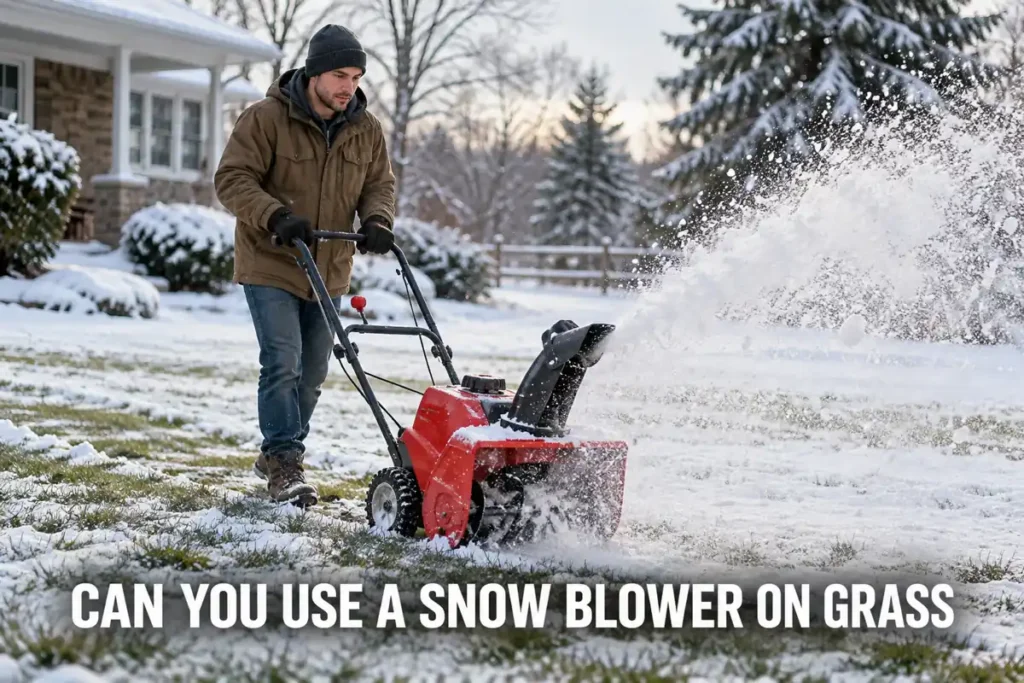
A two-stage snow blower can run on grass when the ground is frozen firm, the skid shoes are lowered so the scraper bar rides above the turf, and the lawn is clear of stones, hoses and wires. A single-stage machine stays off turf, and soft or thawing ground is where compaction happens while even frozen turf can wear. I keep my orchard alleys under snow and keep machines off wet soil, so I read a lawn the way I read a field, by what the ground is doing. Below you get the machine types, the soil, the setup, where the thrown snow lands and the spring repair.
Can You Use a Snow Blower on Grass? The Short Answer
A snow blower on grass works when five conditions are met, and the machine type and the state of the ground come first.
- A two-stage machine. A single-stage machine works at the surface and stays off turf.
- Firm, frozen ground. The soil is frozen hard and the surface is dry.
- Lowered skid shoes. The scraper bar rides above the turf.
- A cleared lawn. No stones, sticks, hoses or wires lie under the snow.
- A place for the snow. It lands thin, away from beds, tree bases and drip lines.
The ground decides the outcome, and a wet thawing surface over soil that is still frozen below is the worst case, as the ground section below explains (1).
The Rule I Follow
Lawn only when it is frozen firm, with a two-stage machine, the shoes lowered and the stones picked up. In a thaw the machine stays on hard surfaces and a shovel does the grass.
Which Type of Snow Blower Suits a Lawn
What touches the ground sorts snow blowers for lawn use. A two-stage machine rides on skid shoes and a scraper bar, the steel strip across the bottom of the housing, while its auger turns above the surface. A single-stage snow blower gathers snow with a paddled or steel auger that cleans down to the pavement.
| Machine type | What touches the ground | What makers say about unpaved ground |
|---|---|---|
| Single-stage | The auger or paddles work at the surface | Toro: should not be used on unpaved surfaces. EGO, Greenworks, DeWalt and Milwaukee manuals: “Do not use on graveled surface” |
| Two-stage | Skid shoes and a scraper bar carry it, and the auger turns above the surface | Toro: can be used on gravel driveways. EGO: skid shoe height is adjustable |
| Power shovel | A small auger works at the surface | Toro rates its 38361 for decks, patios and steps |
A lawn is unpaved, so I treat Toro’s single-stage line as covering it and keep a single-stage machine off turf. When I must cross grass I use a two-stage snow blower, because its shoes and scraper bar, not the auger, set how close it comes to the soil.
What the Manuals Say About Grass
The operator’s manuals below neither approve nor forbid grass. Most ban gravel outright, the EGO two-stage manuals allow it only once the machine is adjusted, and EGO and Milwaukee tell you to clear the area first.
| Model | Wording | What it means for grass |
|---|---|---|
| EGO SNT2800 and SNT2410, two-stage | Gravel only “unless the snow blower is adjusted for such a surface”. Skid shoes “adjust the distance between snow scraper and ground”. The area must be “free of stones, sticks, wires, gravel, and other objects” | No grass line. Gravel is allowed only after the machine is adjusted, and the lawn must be cleared first |
| EGO SNT2130 and SNT2120AP, single-stage | “Do not use on graveled surface”. Same warning about stones, sticks and wires | No grass line. Gravel is banned outright and is the only ground named |
| Greenworks 2600402 | “Do not use on graveled surfaces” and, in another line, “Adjust the housing height to clear gravel or crushed rock surface” | No grass line. The two lines conflict, so I read gravel as banned |
| Milwaukee 3036, single-stage | “Tall grass can hide obstacles”, and rocks and tree limbs must be removed | The only mention of grass: hidden objects |
A manual that is silent about grass has not approved it, so I follow the closest rules it gives: the skid shoe adjustment and the warning about stones and wires.
Weight and Power Type
For electric snow blowers used on lawns, weight matters more than the motor. The EGO SNT2130 single-stage weighs 66 pounds without battery and the EGO SNT2800 two-stage weighs 181 pounds. Makers give weights, not ground pressure, so my rule of thumb is that the heavier the machine, the firmer the ground I want under it. I compare seven corded and battery models in my electric snow blower picks.
Gas adds fuel and exhaust. Start and run gas snow blowers outdoors only, never in a garage even with the door open, because of carbon monoxide. I put ear protection on before the engine starts and refuel outdoors with the engine stopped and cooled.
Frozen Ground, Soft Ground and Thaw
The soil under the snow is frozen firm, wet or partly frozen, or thawing, and each state asks for a different answer.
Frozen Ground Versus Thawing Ground
Nebraska extension says wear injury becomes more likely on frozen soil as winter continues, but little soil compaction occurs (1). Compaction means soil particles pressed together, so air and water move through the soil less. It builds when traffic crosses wet or partly frozen soil, and frozen turf can still have its leaves and crowns crushed.
The thaw is the trap. On my plain, ground that is hard at dawn often turns soft by midday, so I cross the lawn early or not at all. When the surface starts to give under my boot, the pass is over. I never run a machine on the orchard alleys, so the cover crop and the soil under it stay untouched until spring.
Nebraska extension adds that winter traffic damage is hard to repair in spring and that traffic should be spread over different routes (1). I vary my line, so no one strip takes every pass.
What One Frost Trial Found
In one Clemson University trial on a frosted creeping bentgrass putting green, a 92-kilogram (about 200-pound) walk-behind greens mower lowered turf quality more than foot traffic (2). The damage stayed in winter and early spring, and every plot had acceptable quality by the end of March. A putting green is a different turf from a home lawn and a mower is a different load from a snow blower, but the pattern helps.
How to Set Up the Machine for Grass
Setup comes down to where the scraper sits, how you walk the pass and where the snow goes.
Lower the Skid Shoes
The skid shoes bolt to each side of the housing and set how high the scraper bar rides. Shut the machine off before you touch them: stop a gas engine and pull the key, unplug a corded model, or take out every battery pack and the start key where there is one, then wait until every moving part has stopped.
Slide the shoes down and the machine sits higher, so the scraper bar and the auger housing rise above the ground. Retighten the nuts on both shoes at the same height. According to EGO, the shoes “adjust the distance between snow scraper and ground”, with a metal side for rough surfaces and a non-marring side for other surfaces. A lawn is not rough, so I run the non-marring side.
Makers give the same instruction for gravel: the Toro 39926 manual says to adjust the skids further down. On turf I lower the shoes until the bar clears the grass, because I do not want a steel edge dragging across sod. No manual sets a height for grass, so I check the first strip behind me for scuffed or torn turf. I compare five two-stage models in my snow blower for gravel driveways guide.
On my gravel yard I moved the shoes down so the machine stopped picking up stones, and the shoes wore faster there.
Make the Pass
Once the shoes are set, the pass is slow and plain. Follow these steps in order. I explain pass patterns and wind direction in my guide to use a snow blower.
- Test the ground. I press my heel into the turf at the edge of the lawn. If it leaves a print or the surface gives, the job waits.
- Walk slowly and keep the housing level. I keep it level so one corner of the scraper bar does not dig into the turf.
- Leave a thin layer of snow. That is the price of keeping the scraper off the turf.
- Throw across the lawn or with the wind. Aim at open grass, never at people, cars or windows, and keep bystanders and pets at least 100 feet away, as EGO says. Throwing into the Košava, the strong southeast wind on my plain, blows the snow back onto the cleared ground.
- Keep to the slope limits. EGO says not to operate its snow blower on grades steeper than 10%, and Milwaukee sets 15 degrees for the 3036. I skip steep ground.
- Stop when the surface softens. The pass ends when your boot starts to sink.
Clear a Clog the Manual’s Way
Never put a hand in a clogged chute or auger. Release the controls, stop the engine and take out the key on a gas machine, unplug a corded one, or take out every battery pack and the start key where there is one, then wait until every moving part has stopped (EGO’s manuals give 10 seconds, so follow the wait in your own manual). Use the clean-out tool, or a stick when the kit has none. In a US emergency room survey from 2009 to 2017, about 22% of the hand injuries from clearing a clogged snow blower were amputations (3).
Walk the Lawn Before the First Snow
The machine cannot see what the snow hides, so the walk comes before the storm. According to EGO, the area to be cleared must be free of stones, sticks, wires, gravel and other objects that could be thrown and cause serious injury.
- Stones and sticks: pick up every one, and check the soft edge of any gravel path, where stones work into the grass.
- Hoses, cords and toys: coil the hose, lift the extension cord and bring in the toys.
- Beds and tree bases: mark their edges with stakes tall enough to stand above the snow.
Grass creeps in at the soft edges of my gravel yard, so I walk that strip first and pick out the stones before the pass. I drain my drip lines before the first hard freeze and stake each one near the lawn.
Thrown Snow, Piles, Snow Mold and Salt
Throw clean snow thinly across open grass and keep concentrated piles off vulnerable turf and planting areas, because whatever lands there stays until spring. The chute setting matters too, and a separate piece explains how far to throw snow for your drive.
Spread the Snow Thin
Rough arithmetic shows why the landing strip matters. A 21-inch machine clearing a 100-foot path through 6 inches of snow takes in about 88 cubic feet of loose snow. Thrown across a lawn strip 10 feet wide, that snow lands about 1 inch deep, and thrown into a strip 3 feet wide it lands about 3.5 inches deep.
I throw snow onto the gravel edge or an open strip of grass, never against a tree base, the pump-head shelter or a drip line.
Snow Mold and Compacted Piles
Snow mold is a turf fungus disease that develops under snow cover and shows once the snow melts. Purdue turf specialists say gray snow mold needs 45 or more days of snow cover to infect turf (4). University of Illinois Extension says a deep and prolonged snow cover on unfrozen soil favors the disease (5).
Maryland Extension lists persistent snow cover from driveway or sidewalk clearing among the conditions that favor gray snow mold, and it advises against walking on a snow-covered lawn because compacted snow melts slowly (6). A pile melts last, so the pile site deserves the most care.
Iowa State Extension lists not throwing or piling snow on problem areas among the ways to reduce snow mold in later years (7). To me, a spot that browned after last winter’s snow is a problem area, and it gets no pile.
Salt in Thrown Snow
Snow from a salted drive or walk carries the salt with it. UConn Extension says turfgrass can suffer salt injury, with browning of leaf and crown tissue that can be severe, and it advises against shoveling or plowing salt-contaminated snow onto plants. Where irrigation is available, it advises flushing the soil in spring with at least 6 inches of water (8).
Throw snow from a salted surface onto gravel or a hard edge, not onto turf or beds. I skip salt near the plum row and use sand for traction on the path.
Spring Repair After a Snow Blower Crosses the Lawn
Snow mold marks usually heal as the grass grows, and the rest of the repair is a short list of chores.
- Walk the throw path. I pick up the stones and sticks the machine threw before the first mowing, because the mower would throw them again.
- Rake matted patches. I rake gently so the grass dries out and stands up.
- Give the grass time. Iowa State Extension says snow mold patches show up as the snow melts, are usually not serious and green up more slowly than the rest of the lawn (7).
- Fix bare strips and torn sod. If a strip is still bare once growth is under way, I scratch the soil and reseed it. If the scraper lifted a flap of turf, I press it flat when the ground thaws and keep it from drying out.
When a Shovel or Power Shovel Is the Better Choice
A hand shovel is the better tool when the ground is soft or thawing, and a power shovel suits thin snow on hard, delicate surfaces. My EGO SNS1201 shovel review covers a 12-inch battery power shovel for walks and decks.
- Soft or thawing ground. A hand shovel puts almost no weight on the soil, so it is the tool for a thaw.
- Thin snow on hard surfaces. For a thin layer of snow on a deck, patio or step, I reach for a power snow shovel. The EGO SNS1201 weighs about 14 pounds without battery and the Toro 38361 weighs 16 pounds.
- Pavers, decks and patios. Toro rates its 38361 for decks, patios and steps, and a blower’s scraper bar can catch the raised edge of a paver.
Most of my snow work happens on the concrete pad in front of the machinery shed and on the path to the house door, hard surfaces where a low scraper works cleanly. The scraper bar caught the raised edge of that pad once. The lawn is the exception, and on a soft day I pick up the shovel.
The Lawn Routine I Follow
Four things carry the whole job: frozen firm ground, a two-stage machine, lowered skid shoes and a lawn cleared of stones and wires. A stone picked up in autumn is a stone the machine never throws. If you have not bought yet, my guide on what size snow blower do I need works it out from driveway length, snow and surface.
I check the soil at dawn, run the pass early, throw the snow thin onto open grass and put the machine away when the surface starts to give. In spring I walk the throw path for stones before the first mowing. Walk your lawn this week and stake the edges before the snow, and a snow blower on grass becomes a routine job instead of a spring repair. I explain how to store a snow blower at the end of the season, with its cleaning, battery and fuel steps.
Frequently Asked Questions
Is it okay to use a snowblower on grass?
It is okay to use a snowblower on grass when the ground is frozen firm, the machine is a two-stage with the skid shoes lowered so the scraper clears the turf, and the lawn is free of stones and wires. Leave it in the shed on soft or thawing ground, where the weight compacts the soil and the damage is hard to fix in spring.
Can you use a single stage snow blower on grass?
A single-stage snow blower is built to clean down to the pavement, and Toro says single-stage machines should not be used on unpaved surfaces. A lawn is unpaved, so I use a two-stage machine with lowered shoes or a shovel on turf.
Can a snow blower be used on pavers?
A snow blower can be used on pavers when the skid shoes are on the non-marring side, as EGO’s manuals describe for surfaces that are not rough, and the scraper bar clears any raised edges. A power shovel with a plastic or rubber edge is the gentler choice.
Can you use a snow blower on a gravel driveway?
A snow blower can be used on a gravel driveway when it is a two-stage machine with the skid shoes lowered so the scraper rides above the stones. The EGO, DeWalt and Milwaukee single-stage manuals say not to use those machines on gravel.
Can you put a snow blower on a riding lawn mower?
According to Husqvarna, a snow blower attachment exists for its R 322T AWD riding mower, so a riding lawn mower can take one when its maker lists a matching attachment. Check your own maker’s list for your exact model before you buy.
References
- Gaussoin R. Winter traffic and play on turfgrass. University of Nebraska-Lincoln Turfgrass Science (extension article). December 6, 2022.
- Baldwin CM, Liu H, McCarty LB, Luo H, Toler JE, Long SH. Winter foot and equipment traffic impacts on a ‘L93’ creeping bentgrass putting green. HortScience. 2008;43(3):922-926.
- Hammig B, Jones C. Hand injuries associated with reaching into a snow blower to clear clogged snow. Am J Emerg Med. 2020;38(4):785-788.
- Latin R. Snow Molds in the Winter of 2013-14. Turfgrass Science at Purdue University (extension article). 2014.
- University of Illinois Extension. Gray snow mold. Plant Problems (extension page). No date shown.
- University of Maryland Extension. Diseases of home lawns. Updated March 16, 2026.
- Iowa State University Extension and Outreach. Why aren’t snow-covered lawn areas greening up in the spring? Yard and Garden. Last updated August 23, 2024.
- Wallace V, Siegel-Miles A. Preventing and reducing salt injury on school properties. UConn Extension Integrated Pest Management. 2025.
Safety Note: Snow blowers throw snow, ice and hidden objects with force. Never reach into a clogged chute or auger. Shut the machine off first: stop the engine on a gas model, unplug a corded model, or remove the safety key and every battery pack from a battery model. Wait at least as long as your manual says, often 10 seconds, and until every moving part has stopped, then remove the key and disconnect the spark plug wire where your manual says so, and clear the clog with the clearing tool. Keep people and pets out of the discharge path, run gas models outdoors only, and read the manufacturer’s manual.