
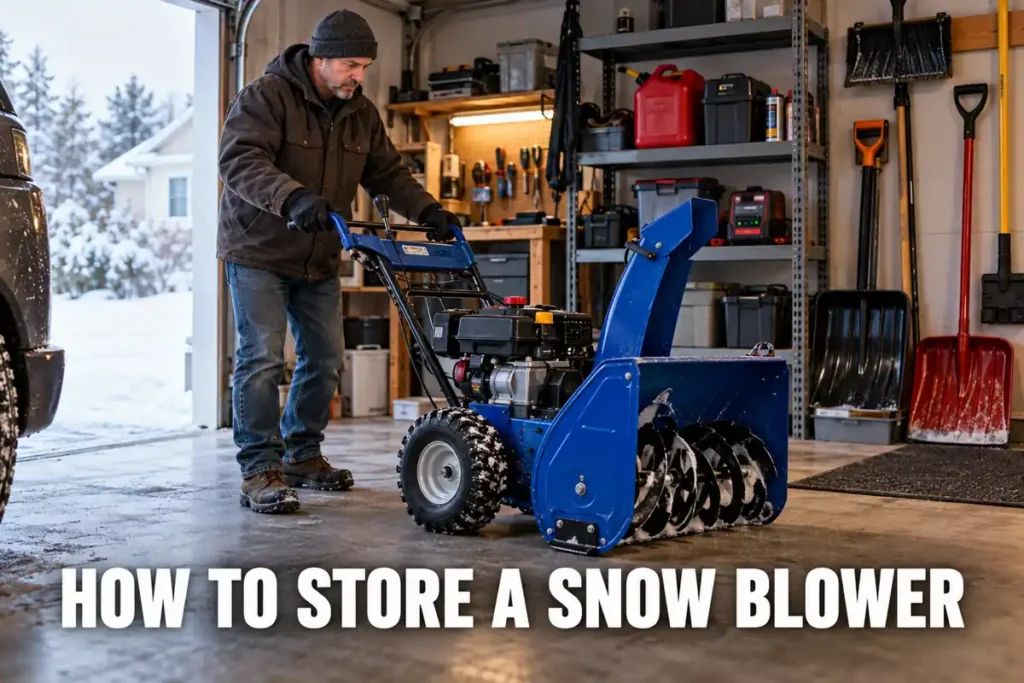
How to store a snow blower comes down to eight steps: treat the fuel or shut the machine down and take out the battery or unplug the cord, then clean and dry it, protect the bare metal, and keep it upright, dry and indoors. The battery packs live in the house even when the machine stays in the shed. I lay up a snow blower the way I lay up a sprayer for winter: shut it down, clean it, dry it, oil the bare steel and deal with whatever can go stale. Below are the steps, the figures each maker prints for its own packs and engines, the lab work behind the charge advice and the fall check that follows.
How to Store a Snow Blower in Eight Steps
The list below doubles as a checklist for storing a snow blower for summer, and it holds after a winter that never brought a storm. The sections after the list give the maker figures.
- Run the machine a few minutes after the last use. DeWalt and Ariens say it clears the snow so the auger or impeller cannot freeze in place, and Cub Cadet gives the same step.
- Treat the fuel (gas models only), outdoors. Add stabilizer and run the engine, or run the tank dry.
- Stop it and let it cool. Release the controls and wait until every moving part has stopped. Cub Cadet says a gas engine needs at least 5 minutes before storing, and Ariens says completely.
- Take out the packs and the safety key, or unplug a corded model. Toro says not to store the tool with the pack installed. On a gas model, Cub Cadet says to remove the safety key or disconnect the spark plug wire before any work.
- Clean and dry it, only after the pack is out. A dry cloth suits a battery model, since DeWalt says not to wash its snow blower with water; Ariens allows mild soap and low-pressure water on a gas model.
- Inspect and tighten the fasteners, scraper bar, skid shoes, paddles and cables.
- Protect the metal. Touch up chips and put a light film of oil or rust preventative on bare steel, as Ariens and Cub Cadet describe. Toro has you lubricate the hex shaft each year; keep oil off rubber friction wheels and drive plates, where it makes the drive slip.
- Store it upright, level, dry and indoors, with the packs in the house.
Follow Your Own Manual
Makers disagree on the charge level for a stored pack and on how long to run a gas engine after adding stabilizer. I name each maker’s figure below. Use the one in your own manual.
Clean and Dry the Machine First
Melted snow and road salt corrode bare steel in a stored snow blower, so cleanup comes early. Run it a few minutes, stop it, let it cool, take out the key and the pack, and only then wipe it dry.
- Battery models: EGO’s SNT2800 manual says to wipe moisture, dirt and debris from and around the battery compartment and to wipe the machine with a clean dry cloth. DeWalt warns that washing its snow blower with water voids the warranty.
- Gas models: Ariens allows mild soap and low-pressure water to remove salt and ice-melt residue, never high pressure.
Keep the machine away from fertilizer and rock salt while it sits. EGO says not to store it near these corrosive materials, and Toro adds garden chemicals and de-icing salts. The fertilizer in my machinery shed stands at the far end from the snow blower.
Then touch up chipped paint, as Toro’s manual says, after sanding the spot and using a rust preventative. Ariens and Cub Cadet call for a light layer of oil on bare metal, and the oil stays off rubber friction wheels and drive plates, where it makes the drive slip. Last, wipe up the water that drips off the machine, which EGO’s manual treats as a slip hazard.
Check the Wear Parts While the Machine Is Empty and Idle
Storage is the cheapest time to find a worn part. Make the machine safe first, in the order the manuals give: release the controls, stop the engine and remove the key on a gas model (disconnect the spark plug wire for engine work), unplug the cord on a corded one, or take out the key and every battery pack on a battery model, then wait until every moving part has stopped. EGO names 10 seconds, Toro says to wait for all moving parts to stop, and a trigger lock or the off position never replaces that. Let a hot gas engine cool before you touch it.
The authors of a US emergency-room study covering 2009 to 2017 call hand injuries the main injury threat for snow blower operators (1). Their study is about clogged chutes, but tipping a machine back to oil a shaft puts your hands near the same auger and scraper bar, so I take the battery out before I tip mine. A jammed chute is the usual reason hands go in, and I explain why a snow blower keeps clogging on its own page.
- Fasteners: EGO says to check all nuts, bolts, knobs and screws for tightness.
- Scraper bar, skid shoes and paddles: Toro says to check the skids and the scraper and adjust them if necessary. Milwaukee says to replace the rubber paddles and the scraper bar together each year on its 3036 model.
- Hex shaft, cables and shear pins: Toro says to inspect the cables and lubricate the hex shaft every year on its e26. On models that have shear pins, confirm each one is in place and not bent. My page on snow blower shear pins explains which machines have them.
I look at the scraper bar and paddles in spring and order what is worn then, because the first storm is a poor day to find a worn scraper. I explain how worn parts affect the life of the machine in my guide to how long snow blowers last.
How to Store Snow Blower Batteries for Winter or Summer
The table shows each maker’s charge level and storage temperature beside its manual.
| Maker and manual | Charge level for storage | Where the pack may sit |
|---|---|---|
| EGO, SNT2800 manual | No charge level printed | An enclosed area where the temperature will not drop below -4°F (-20°C) |
| Toro, Power Max e26 (39926) manual | Charge until 2 or 3 LEDs are green; do not store a full or empty pack | 41°F to 104°F (5°C to 40°C) for charging and storing; never outside or in vehicles |
| DeWalt, DCSNP2142 manual | Fully charged and out of the charger for long storage; never completely depleted | Cool and dry; not where the temperature may reach 104°F (40°C), such as outside sheds or metal buildings in summer |
| Greenworks, 80V snow thrower manual | No charge level printed | Indoors; do not store or charge the battery outside |
| Milwaukee, M18 FUEL 3036 manual | No charge level printed | An indoor, dry, even, locked-up place |
The makers disagree on charge level, so follow the manual for your own pack. Where it gives none, I leave the pack at a partial charge, never empty, on a shelf in the house with my other batteries. For the other packs in the shed, I also explain how to store leaf blower batteries over winter in six steps.
What the Lab Work Says About Charge and Heat
Lithium-ion cells lose capacity from time alone, which is called calendar aging. In one lab study, pouch cells held at full charge for nine months lost about 10% of their capacity at 95°F (35°C) and about 43% at 140°F (60°C), while cells held at 0% charge lost almost none (2). A study of 18650 cells at 16 charge levels also found that a high storage charge speeds the loss, and its authors say to avoid it (3). These are lab cells, not tool packs, but they show the direction.
A full pack in a hot shed is the case to avoid. Long storage at full charge and high temperature speeds capacity loss in the lab cells, though the studies cannot tell you the percentage for your own pack. DeWalt’s 104°F limit names outside sheds and metal buildings in summer as places to avoid. A pack on a shelf in the house stays far below it.
An empty pack is no safe harbor either. Lab cells driven far below empty dissolved copper inside and developed an internal short circuit (4), which fits Toro’s and DeWalt’s rule against storing an empty pack.
In 2025 the weather station at Palić in northern Serbia recorded no day with snow cover. In a winter like that, my machine and its pack sit unused from one fall to the next, and idle-time ageing is the only kind they get.
Why a Cold Pack Warms Up Before It Charges
Resting in the cold is allowed down to each maker’s floor, and EGO’s is -4°F. Charging in the cold is where the damage happens. OSHA warns that charging a lithium-ion battery when it or its surroundings are below freezing (32°F) can cause permanent lithium plating and raise the risk of failure (5). In lab cells cycled at -20°C (-4°F) or below, metallic lithium deposited on the anode and caused permanent capacity loss (6).
DeWalt says not to charge below 40°F, and its charger shows a message to bring a too-cold pack inside to warm to room temperature. If a pack has gone cold, bring it into the house and let it come up to room temperature before it goes onto the charger. Charge times by maker sit on my page about charging a snow blower battery.
Handle Stored Packs Safely
Keep metal objects off the terminals, as DeWalt warns, and keep packs out of children’s reach, as EGO and Milwaukee say. Do not store a swollen or damaged pack; ask the maker how to dispose of it.
Gas Snow Blowers Need Fuel, Oil and Spark Plug Care
A gas engine adds fuel, oil and spark plug work, and the makers do not agree on every step. This is the short version of winterizing a gas snow blower. The storage page of your engine manual has the full routine for your model and overrides this section.
Fuel Routes and Run Times by Maker
| Maker and manual | Fuel route | Engine run time |
|---|---|---|
| Ariens, Deluxe manual | Add stabilizer, run the engine outdoors, close the fuel valve and let the engine stop on its own | At least 5 minutes |
| Cub Cadet, engine manual for the 357 cc and 420 cc engines | Add stabilizer as its label says, or empty the tank by running the engine dry | At least 10 minutes after adding stabilizer |
| Toro, single-stage tip sheet | Run the fuel system dry | None printed |
Cub Cadet’s engine manual ties the route to the time in storage: stabilizer for 30 to 90 days, drained fuel beyond 90 days. It warns that skipping both can damage the carburetor, and the warranty does not cover that damage. Use one maker’s route from one document. After one summer on old fuel, a gas machine of mine started rough in fall.
- Oil: Toro says to change the oil while the engine is warm, and Cub Cadet’s engine manual calls for an oil change before extended storage. How often to do a snow blower oil change depends on maker and engine, and my separate page lists it.
- Cylinder: for long storage, Cub Cadet’s engine manual puts 1/2 ounce (15 ml) of clean engine oil into the spark plug hole and has you pull the recoil rope slowly twice, with the key off and the plug wire grounded, because fuel can spray from the hole.
- Fuel near heat: Ariens says never to store the machine with fuel in the tank inside a building with ignition sources such as hot water heaters, space heaters or clothes dryers. Cub Cadet gives the same rule.
Gas Engines Run Outdoors Only
Run a gas engine outdoors for the stabilizer run, for running the tank dry and for any test, never in a garage or shed, even with the door open, because of carbon monoxide. Refuel outdoors on a cool engine.
Snow Blower Storage in a Dry, Enclosed Place
Keep the machine in a clean, dry, protected building. The manuals from EGO, DeWalt, Milwaukee, Ariens and Cub Cadet all point to that kind of place, and the battery packs go into the house even when the machine does not.
Garage, Shed or Basement
Snow blower garage storage is the easy case: a dry floor, a door and room to park the machine upright. The catch is a water heater, furnace or dryer in the same garage, and Ariens and Cub Cadet say never to store a machine with fuel in the tank in a building with such ignition sources. That garage is out for a fueled machine.
A snow blower storage shed works when it keeps the rain out and the floor sits off the bare dirt. Toro’s single-stage tip sheet says to store the machine in a dry area, but not in your house or basement.
Upright, Level and Off the Floor
DeWalt and Cub Cadet say to store the machine upright with both wheels and the auger housing on the ground. Ariens puts blocks under the frame or axle for long storage, to take the weight off the wheels or tracks. Keep a gas engine level, because Cub Cadet’s engine manual says tilting can leak fuel or oil.
My machinery shed has a floor of dirt and concrete, so I park the snow blower on the concrete part with a board under the wheels, and in spring I check the floor for damp.
Snow Blower Outdoor Storage and Covers
Ariens says not to store its unit outdoors, and a machine whose manual requires indoor storage goes indoors. Where the manual allows outdoor storage, raise the machine off the ground and use a fitted, breathable snow blower storage cover that stops short of the ground so air can move. A tight plastic sheet traps moisture against the metal. That is my practice, not a maker rule, and Toro’s tip sheet says only to use a protective cover.
The pack never stays outside. Toro says not to store it outside or in vehicles, Greenworks says not to store or charge it outside, and EGO’s floor is -4°F.
Getting It Ready Again in Fall
Storage is half the job. The other half is a short fall check, so the machine is ready before the first forecast storm. If the machine fails to fire on the first pull, see my fixes for a snow blower that won’t start.
- Charge the packs. Toro says to charge until all 4 LEDs are green, and DeWalt says not to charge below 40°F, so warm a cold pack first.
- Check tire pressure. EGO’s SNT2800 manual gives 16 psi cold, and Toro’s 39926 manual gives 17 to 20 psi.
- Use fresh fuel on a gas model, filled outdoors on a cool engine. Cub Cadet says a little smoke at startup is normal after an oiled cylinder. I explain gas, battery and corded starting procedures in my guide on how to start a snow blower.
I charge the packs the night before a forecast storm, and I run the machine once on the cleared pad before the first one.
What I Do With the Machine When the Snow Stops
Three habits protect it: the pack goes into the house, the bare metal gets a light film of oil, and the maker’s storage page overrides any general list. When the snow stops, I run the machine a few minutes, pull the pack and carry it to the house, wipe the machine dry, then park the machine on the concrete part of the shed floor. In a winter with almost no snow it sits for twelve months, so the spring wear-part check and the fall check still matter. Read the storage page of your own manual before the first warm week, and you know how to store a snow blower the way its maker wants it kept. Pass patterns and wind rules are on my separate page on how to use a snow blower.
Frequently Asked Questions
Can I store my snow blower outside in winter?
You can store a snow blower outside in winter only if its manual allows it, and Ariens says in its manual not to store the unit outdoors. If yours does allow it, keep the machine off the ground under a breathable fitted cover, and keep the pack in the house, since Toro and Greenworks say never to store it outside.
How to store an EGO snow blower?
To store an EGO snow blower, take out the battery packs, wipe the battery compartment and the machine dry, and check the nuts, bolts, knobs and screws for tightness, as EGO’s SNT2800 manual says. Keep the packs in an enclosed place that stays above -4°F and the machine in a clean, dry, enclosed place away from fertilizer and rock salt. That manual prints no storage charge level.
What is the average lifespan of a snow blower?
The average useful life of a snow blower is six years in DeWalt’s manual, which cites the CPSC, and seven years in Cub Cadet’s manual. DeWalt says to have an authorized dealer inspect the machine every year once it passes that age.
How to store a snow blower for summer?
To store a snow blower for summer, follow the eight steps above: run it, treat the fuel or stop it and take out the packs, clean and dry it, protect the bare metal and park it upright in a dry building. Summer adds heat as the new risk, since DeWalt says not to keep its tool or pack where the temperature may reach 104°F, such as in outside sheds or metal buildings.
What are the downsides of using an electric snow blower?
One downside of using a battery-powered electric snow blower is the off-season care its packs need: they come off the machine, spend the summer indoors and sit at the charge level your manual names. In return the machine avoids gasoline and engine-oil changes, but it still needs the inspections, wear-part replacement and lubrication its manual lists.
References
- Hammig B, Jones C. Hand injuries associated with reaching into a snow blower to clear clogged snow. Am J Emerg Med. 2020;38(4):785-788.
- Mao Z, Farkhondeh M, Pritzker M, Fowler M, Chen Z. Calendar Aging and Gas Generation in Commercial Graphite/NMC-LMO Lithium-Ion Pouch Cell. J. Electrochem. Soc. 2017;164(14):A3469-A3483.
- Keil P, Schuster SF, Wilhelm J, et al. Calendar Aging of Lithium-Ion Batteries. J Electrochem Soc. 2016;163(9):A1872-A1880.
- Guo R, Lu L, Ouyang M, Feng X. Mechanism of the entire overdischarge process and overdischarge-induced internal short circuit in lithium-ion batteries. Sci Rep. 2016;6:30248.
- Occupational Safety and Health Administration. Preventing Fire and/or Explosion Injury from Small and Wearable Lithium Battery Powered Devices. Safety and Health Information Bulletin SHIB 06-20-2019. US Department of Labor; 2019.
- Lin H-p, Chua D, Salomon M, et al. Low-Temperature Behavior of Li-Ion Cells. Electrochem Solid-State Lett. 2001;4(6):A71.
Safety Note: Snow blowers throw snow, ice and hidden objects with force. Never reach into a clogged chute or auger. Shut the machine off first: stop the engine on a gas model, unplug a corded model, or remove the safety key and every battery pack from a battery model. Wait at least as long as your manual says, often 10 seconds, and until every moving part has stopped, then remove the key and disconnect the spark plug wire where your manual says so, and clear the clog with the clearing tool. Keep people and pets out of the discharge path, run gas models outdoors only, and read the manufacturer’s manual.