
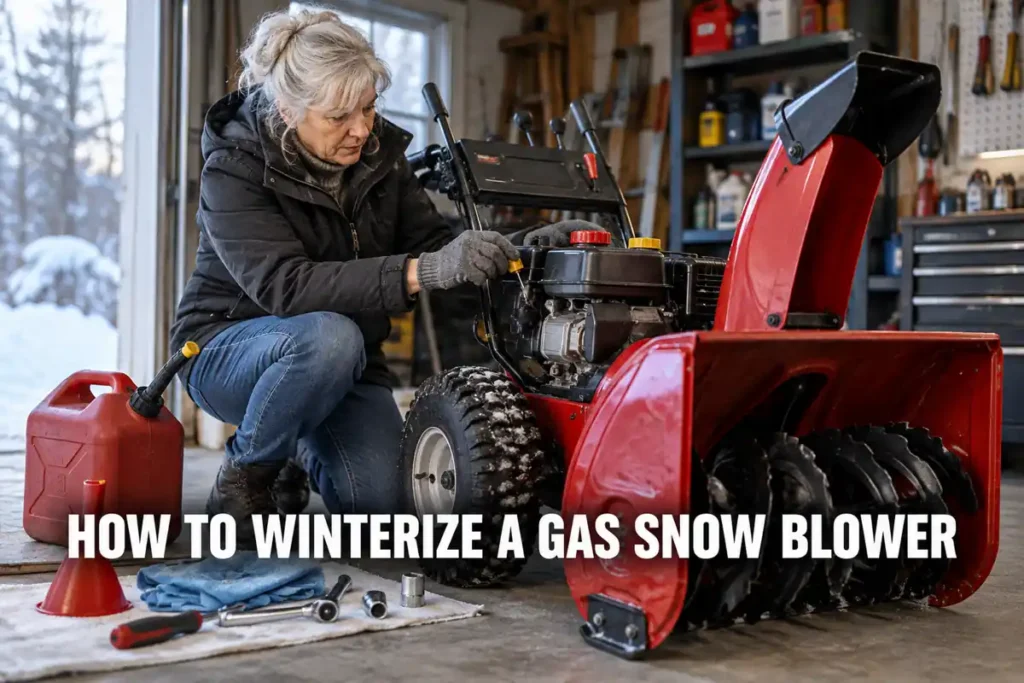
Here is how to winterize a gas snow blower, in five jobs and this order: deal with the fuel, change the oil, oil the cylinder, clean the machine and check the wear parts, then store it level and dry. The fuel job decides whether it starts next winter. I treat the fuel the way I treat my drip irrigation lines before the first hard freeze: whatever sits in the system all winter is what damages it. Below are the five steps with each maker’s own run times and oil amounts, the short check before the first snow, and the mistakes that cost a carburetor.
How to Winterize a Gas Snow Blower in Five Steps
Winterizing a gas snow blower means preparing it to sit for months without fuel gumming the carburetor or rust taking the bare steel. Makers and shops use the word for end-of-season storage, and that is how I use it here. Work with the engine off, the key out and the spark plug wire disconnected. The engine runs only for the cleaning run and the fuel run at the start, and both happen outdoors.
- Fuel: run the auger and impeller outdoors to throw off melting snow, then add stabilizer to fresh gas and run the engine so treated fuel reaches the carburetor, or empty the tank and carburetor, depending on how long the machine will sit.
- Oil: change the engine oil while the engine is warm, after the fuel is out.
- Cylinder: pull the spark plug, check it, and put a small measured amount of clean engine oil into the cylinder.
- Clean and check: wash off salt, check the wear parts and wipe bare metal with a light film of oil.
- Store: keep it level and dry, indoors, away from furnaces, water heaters and clothes dryers.
Follow Your Own Manual
Makers disagree on how long to run the engine after adding stabilizer, on whether to store with a full or an empty tank, and on how much oil goes into the cylinder. I give each maker’s figure with its name. Follow the manual for your machine and engine.
What Winterizing Means for a Snow Blower and When to Do It
Storage prep comes once the last snow is gone, and a smaller check comes in autumn, near the end of this guide. How long the machine will sit sets the fuel plan. Cub Cadet draws its line at 90 days, Honda at three months and Toro at 90 days for stabilized fuel. In a winter with almost no snow, which the plain around my farm sometimes has, the machine can sit most of a year.
Safety First, and What to Gather
Most of the risk comes from fuel and from the engine running. Stop the engine, wait until every moving part has stopped, take the key out, and disconnect the spark plug wire and ground it against the engine, as Cub Cadet’s engine manual says. The shutdown routine for the chute has more detail in my page on operating a snow blower.
- Fuel outdoors, engine cool. Honda says to let the engine cool before refueling and to handle fuel only outdoors.
- The engine runs outdoors only. The Consumer Product Safety Commission warns that exhaust holds carbon monoxide, which can kill in minutes. In a Seattle series of generator poisonings, 29 of 37 incidents had the generator running in the home environment, most often the garage (1). That series was about generators, but the principle holds for any small gasoline engine.
- Never tip the machine with fuel in the tank. Cub Cadet says to run the engine until the tank is empty before tipping the machine to drain oil, and Ariens says to remove fuel before tipping it onto the housing.
- Hands stay out of the auger and chute. Clear a frozen auger in the manual’s order: release the controls, stop the engine, remove the key, wait the time the manual gives (EGO and Toro name 10 seconds) until every part has stopped, then use the clean-out tool or a stick. A US emergency-room study covering 2009 to 2017 found that 22 percent of hand injuries from clearing a clogged snow blower were amputations (2). To stop the jam before it starts, read why a snow blower keeps clogging.
I fill the machine outdoors on a cool engine, and I carry the fuel can out of the shed to do it.
First, Stabilize or Empty the Fuel
Ariens says gasoline left in the fuel system without a stabilizer, even for short periods, leaves gummy deposits that can damage the carburetor, hoses, filter and tank. You have two safe plans: treat the fuel and run it through, or empty the system. Use fresh gas at E10 or less either way.
Start with the cleaning run: run the auger and impeller outdoors for a few minutes before you park the machine, so loose and melting snow flies off and the impeller cannot freeze in place, as Ariens says. The fuel run below happens in the same outdoor session. For what the auger and impeller actually do, see my answer to how does a snow blower work.
Honda, Toro, Cub Cadet and Ariens all cap ethanol at 10 percent. In NREL and Oak Ridge tests on 28 small engines, exhaust ran 20 to 70 C hotter on E20 than on plain gasoline, because open-loop engines run leaner as the ethanol share rises (3).
Fuel Stabilizer for Snow Blower Storage and How Long to Run the Engine
Add the stabilizer to fresh fuel before it goes in the tank, at the mix ratio on its label, as Ariens and Cub Cadet say. A stabilizer does not repair old gas, and Honda says it will not reconstitute stale gasoline. Then run the engine outdoors so the treated fuel reaches the carburetor. The makers’ run times differ.
| Maker and model | Run the engine | Then |
|---|---|---|
| Ariens Deluxe series, 921069 to 921072 (manual) | At least 5 minutes | Close the fuel valve and let the engine stop on its own |
| Cub Cadet, 357 cc and 420 cc engine manual | At least 10 minutes | No need to drain the stabilized fuel from the carburetor |
| Toro Power Max 726 and 826 OE | 10 minutes | Drain the tank at the fuel shutoff valve, then run the engine until it stops |
| Honda HS720 | 10 minutes | Fuel valve off, restart and run about 3 minutes until the engine stops |
| Troy-Bilt storage page | 3 to 5 minutes | Top off the tank; Troy-Bilt says not to store the machine empty |
Use your manual’s figure. Where it gives no figure, I run the engine the full 10 minutes. That costs a little fuel and goes against none of these manuals.
Ariens sells its own stabilizer and says “or equivalent”, Honda recommends its own, and Cub Cadet and Toro say to use one as its maker directs. Pick the snow blower fuel stabilizer that your engine manual allows.
Oak Ridge National Laboratory aged E10 pump gasoline in sealed one-gallon cans for 12 months, and it stayed within gasoline specifications with no stabilizer at all. Two of the three stabilizers it tried raised measured oxidation stability, but the gain was not needed to meet the specifications (4). Those were sealed cans only, with no carburetor, vented tank or running engine, so I follow the makers’ lines for my machine.
How to Drain Gas From a Snowblower
Draining leaves the carburetor nothing to gum. Empty the tank and the carburetor outdoors on a cool engine, into an approved container. The method depends on the machine.
- Run it dry (Cub Cadet, Ariens): run the engine outdoors until it stops for lack of fuel. Ariens recommends this even when a stabilizer was used. Cub Cadet says never to pour fuel out of the engine and never to leave a running engine unattended.
- Fuel shutoff valve (Toro Power Max 726 and 826 OE): slide the fuel line off the shutoff valve, open the valve and drain into an approved container, then refit the line. Run the engine until it stops, prime and start it again, and run it until it stops. Toro says that when you can no longer start the engine, it is dry enough.
- Carburetor drain screw (Honda HS720): set a pan under the drain tube, turn the fuel valve on, and loosen the screw, without removing it, until the tank is empty. Tighten the screw again once the tank is empty. Many machines have no such screw, so check yours.
If fuel spills, wipe it up and do not start the engine while it is spilled, as Cub Cadet says.
Which Choice Fits Your Winter
The makers draw the line in different places. Days of storage decide the plan.
| Maker and model | Stabilizer plan | Drain plan |
|---|---|---|
| Cub Cadet, 357 cc and 420 cc engine manual | 30 to 90 days | Over 90 days |
| Honda HS720 | Up to 3 months | More than 3 months |
| Toro Power Max 726 and 826 OE | Stabilized fuel for no more than 90 days; gasoline no more than 30 days | Drain at the end of the season |
| Ariens Deluxe series manual and blog | Stabilizer in all fuel, no day limit given | Blog: drain completely even if stabilized |
| Troy-Bilt storage page | Full tank of stabilized fuel, no day limit given | Says not to store the machine empty |
Take a machine last used on March 15 and next needed on December 1. That gap is 261 days by the calendar, past the 90-day line of Cub Cadet, the 90-day limit Toro sets for stabilized fuel and the three-month line of Honda, so all three say to empty the system. A gap of 81 days fits a stabilizer plan where your manual allows about 90. On my farm the long gap is the usual case, so I drain the machine and run it dry.
Forgot to Drain Gas From Snowblower Before Summer
If the fuel sat all summer, do not add stabilizer and hope. Drain the tank by the method above and fill it with fresh gasoline. Cub Cadet says gasoline oxidizes and deteriorates over time, which causes hard starting, and Ariens says to put fresh stabilizer-treated fuel in the tank and in any leftover container before you open the fuel valve. The roughest first start I remember came after fuel had sat in the tank over the summer, and I have treated the fuel as the first job ever since. If fresh fuel does not solve it, I cover gas, battery and corded fixes in my guide to a snow blower that won’t start.
Second, Change the Engine Oil
Change the oil as part of storage prep, after the fuel is out and while the engine is warm but not hot. If your manual has you tip the machine to drain the oil, take the fuel out first; a manual that drains through a plug needs no tipping.
If you keep a full stabilized tank, as Troy-Bilt allows, do not tip the machine; drain the oil by the method your manual shows, such as a sleeve or siphon. Use the oil your manual names. Cub Cadet’s 357 cc and 420 cc engines, for example, call for a four-stroke detergent oil rated SJ or higher, and Cub Cadet says never to use non-detergent or two-stroke oil. Take the used oil to a recycling point. Intervals by maker are listed in my notes on oil changes for snow blowers.
Third, Pull the Spark Plug and Oil the Cylinder
A small measured amount of oil in the cylinder keeps the bore from rusting while the engine sits, and the same visit lets you check the plug. Do it with the fuel already out, because fuel can spray from the spark plug hole when the engine turns over. That is the plan for an empty system; a machine stored with a full stabilized tank skips this step unless its manual gives one.
Cub Cadet says to check the plug yearly, to discard it if the insulator is cracked or chipped, and to replace it if the electrodes are pitted, burned or fouled. Use the plug and gap your engine manual names.
| Maker and model | Oil in the cylinder | After |
|---|---|---|
| Honda HS720 | 1 teaspoon (5 cc) | Pull the rope several times, refit the plug, then pull slowly until you feel resistance, which closes the valves |
| Cub Cadet, 357 cc and 420 cc engine manual | 1/2 fl oz (15 ml) | Rag over the hole, pull the recoil handle slowly with a full arm stroke, repeat once |
| Toro Power Max 726 and 826 OE | 1 fl oz (30 ml) | Pull the starter rope slowly several times, install the plug loosely |
| Ariens Deluxe series manual and Troy-Bilt storage page | No amount given | Follow the engine manual |
The Plug-Out Step Is the Exception
Troy-Bilt says never to crank the engine with the spark plug removed, and Cub Cadet says the same in its plug service section. Its cylinder-oil step is the one exception, and only with the fuel out, a rag over the hole, the key removed and the plug wire grounded. If your manual has no cylinder-oil step, skip it.
Thread the plug back in by hand to prevent cross-threading, and seat it as your manual says before storage.
Fourth, Clean the Machine and Check the Wear Parts
By now the engine is off for good. Remove the key, wait until every part has stopped, and work on the cold machine.
Clean Off Salt Without Soaking the Engine
Road salt and ice melt corrode steel, so Ariens says to wash them off with mild soap and low-pressure water, never high pressure. Do not spray the engine. Cub Cadet says water can contaminate the fuel, soak the air cleaner element or get into the muffler. Dry the machine thoroughly, then wipe a light film of oil onto bare metal.
Check the Wear Parts and Order Spares
Storage is the cheapest time to find a worn part, because the shop is quiet and the machine is empty. My guide on how long snow blowers last covers the wear parts and warranty points to check.
- Scraper or shave plate and skid shoes: Toro says to check them yearly.
- Rubber auger paddles on a single-stage, and belts on any model: replace paddles that are worn, and check belts for cracks, fraying and wear. The paddle design and where it fits are on my page about the single-stage snow blower.
- Friction disc on a two-stage: keep oil off the rubber disc and the aluminum drive plate, as Cub Cadet and Troy-Bilt say.
- Tires: Toro gives 17 to 20 psi for the Power Max 726 and 826 OE. Ariens says never to inflate above the sidewall figure.
- Shear bolts: use only the maker’s part. A hardware-store bolt is not a substitute. Which machines use them is covered in my notes on snow blower shear pins.
Order whatever is worn now, so the repair finishes before the first snow, as Troy-Bilt advises. I check the skid shoes and the scraper on my gravel yard in spring, because stone wears them faster, and I order parts while the shop is quiet.
Fifth, Store It Level, Dry and Away From Ignition Sources
A gas machine with fuel in the tank has two storage rules a battery machine does not have. Keep it level, and keep it away from anything with a flame, a pilot light or a spark.
Cub Cadet names the hot water heater, space heater, clothes dryer and electric motor as the things to keep away from, and Ariens and Honda say to use a well-ventilated dry area away from ignition sources. Ariens says to store the machine inside, and Toro says to let the engine cool first. My machinery shed has a dirt-and-concrete floor and no heat source near where the machine stands, so a level, dry spot is easy to find. Where to keep it, from garage to shed, is the subject of my separate page on storing a snow blower.
Getting It Ready Again Before the First Snow
The second winterizing job is smaller and happens in autumn, and fresh fuel is the point. Before the first start after long storage, Ariens says to add fresh stabilizer-treated fuel to the tank and to any leftover container. Toro warns against storing gasoline for more than 30 days, and Honda says gasoline can degrade in as little as 30 days.
Then check the oil level, the plug, the belts, the scraper and skid shoes, the shear bolts, the tire pressure and the cables. I run the machine outside for a few minutes on a clear autumn day before the first forecast snow. Smoke at the first start is normal after cylinder oil. I explain how to start a snow blower by power type in a separate guide.
Mistakes That Cost You a Carburetor
Most of these mistakes skip a maker’s line, and each is easy to avoid.
- Stabilizer in old fuel. Add it to fresh fuel.
- No run after adding it. The treated fuel has to reach the carburetor.
- Running the engine indoors. The run belongs outdoors, never in a garage or shed.
- Tipping the machine with fuel in the tank. Drain the fuel first.
- Spraying the engine. Ariens bans high-pressure water, and Cub Cadet says not to spray the engine at all.
Done in Spring, Ready by the First Snow
The fuel plan follows how many days the machine will sit, the oil and cylinder steps protect the inside of the engine, and a level, dry spot away from ignition sources protects the rest. The step that pays back first on my yard is the fuel run, outdoors, before the machine goes in for the summer. Write the service date on a tag on the handle, with the next oil change due, so the autumn check starts from a record. That is how to winterize a gas snow blower: fuel, oil, plug, wear parts and a dry, level place, done before it goes in for the summer. For a new gas machine, my best gas snow blower picks start from two-stage models.
Frequently Asked Questions
What is the best fuel additive for a snowblower?
The best fuel additive for a snowblower is the stabilizer your engine manual approves, mixed at the ratio on its label and added to fresh fuel. Ariens sells its own and also says “or equivalent”, and Honda recommends its own, while Cub Cadet and Toro say to use a stabilizer as its maker directs. None of these four names a third-party brand, and none can fix fuel that has already gone stale.
Can you use seafoam in a snowblower?
Seafoam in a snowblower is safe to use only when you can confirm it suits your engine, so use the stabilizer your engine maker recommends otherwise. Ariens, Honda, Cub Cadet and Toro name no third-party brand, and Ariens allows an equivalent. Check that the label calls the product a fuel stabilizer for gasoline engines, that you can follow its mix ratio, and that your manual does not forbid additives.
Should you drain gas from a snowblower?
You should drain gas from a snowblower when it will sit longer than your maker’s line, which is 90 days for Cub Cadet and three months for Honda. Under that line, Cub Cadet has you add stabilizer and run the engine at least 10 minutes, and Honda has you run 10 minutes and then run the carburetor empty. Toro drains at the end of every season, and Troy-Bilt is the exception, since it says not to store the machine empty.
Does a snowblower need an oil change every year?
A snowblower needs an oil change at each maker’s interval, set in hours, seasons or both. Cub Cadet’s 357 cc and 420 cc engines call for a change every season or 50 hours after the first at 5 hours, and Toro’s Power Max 726 and 826 OE every 25 hours after the first 5. Cub Cadet adds a change at storage if the oil has not been changed in the last 3 months.
How do you drain gas from a snowblower?
You drain gas from a snowblower outdoors on a cool engine, either by running the engine until the tank is empty or by opening the fuel shutoff valve into an approved container. Toro’s Power Max 726 and 826 OE manual drains at the valve and then runs the engine until it stops, and Honda’s HS720 adds a carburetor drain screw. Never tip the machine while the tank holds fuel.
References
- Hampson NB, Zmaeff JL. Carbon monoxide poisoning from portable electric generators. Am J Prev Med. 2005;28(1):123-125.
- Hammig B, Jones C. Hand injuries associated with reaching into a snow blower to clear clogged snow. Am J Emerg Med. 2020;38(4):785-788.
- Knoll K, West B, Clark W, et al. Effects of Intermediate Ethanol Blends on Legacy Vehicles and Small Non-Road Engines, Report 1 – Updated. NREL/TP-540-43543; ORNL/TM-2008/117. National Renewable Energy Laboratory; 2009.
- Sluder CS, Davis SC. Assessment of the effectiveness of three aftermarket gasoline fuel stabilizers in preventing gum formation and loss of oxidation stability. SAE Technical Paper 2022-01-0486. 2022. doi:10.4271/2022-01-0486
Safety Note: Snow blowers throw snow, ice and hidden objects with force. Never reach into a clogged chute or auger. Shut the machine off first: stop the engine on a gas model, unplug a corded model, or remove the safety key and every battery pack from a battery model. Wait at least as long as your manual says, often 10 seconds, and until every moving part has stopped, then remove the key and disconnect the spark plug wire where your manual says so, and clear the clog with the clearing tool. Keep people and pets out of the discharge path, run gas models outdoors only, and read the manufacturer’s manual.