
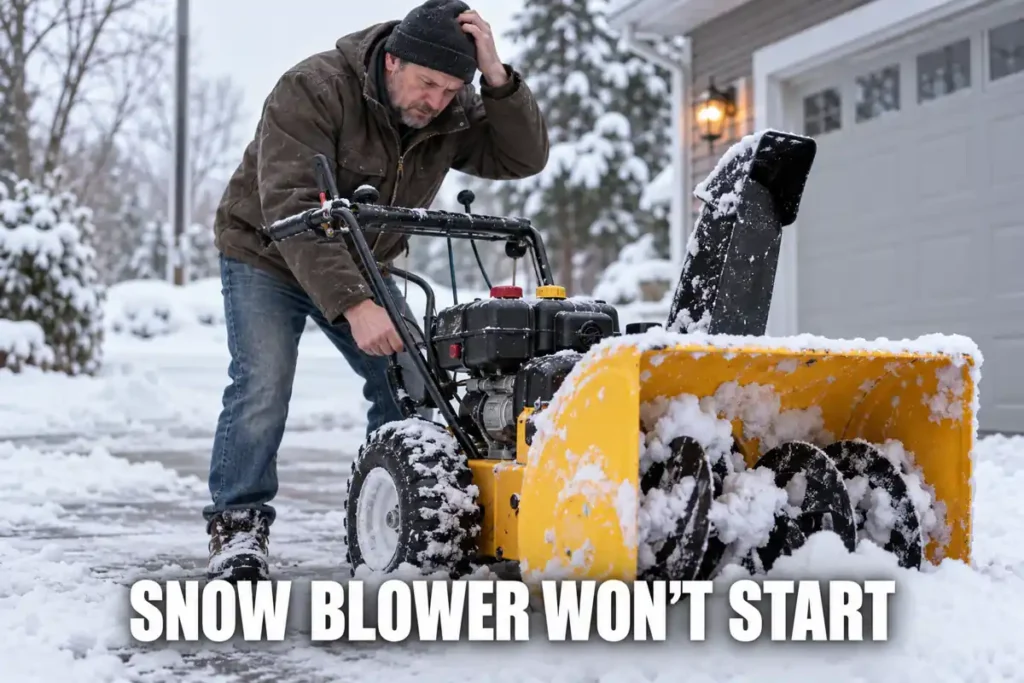
When a snow blower won’t start, one condition is usually missing: a key, an open fuel valve, fresh gas, a charged pack or power at the outlet. Work from the controls to the fuel to the spark, and stop where the maker says to stop.
Snow is scarce on my land in some winters, so my machine can sit for months, and the first start of the season is where trouble shows. This guide covers the shutdown steps first, then the checks for gas, battery and corded machines, and the point where you call a dealer.
Snow Blower Won’t Start: The Short Answer
Most start failures trace to a missing condition, so check what you can see and touch before you suspect a part.
| Power type | Most likely cause | First check |
|---|---|---|
| Gas | A control or key in the wrong position, old fuel, or a flooded engine | Engine key, fuel valve, choke, throttle, then the fuel in the tank |
| Battery | A flat, cold, hot or half-seated pack, or the wrong start order | Pack charge, how far the pack is pushed in, then the start order in your model’s manual |
| Corded | No power reaching the machine | Outlet, cord ends and the interlock key before the power bar |
If a snow blower won’t start in cold air, add two checks to the list: the choke and prime routine on a gas machine, and the pack temperature on a battery machine. Both are covered below, one power type at a time. When the machine just needs the normal start order, I lay it out for each power type in an article on how to start a snow blower.
Shut It Down First: Safety Before Any Check
Every check below starts with the machine off and its power source removed. Reaching into a stuck snow blower is how owners lose fingers: in a US emergency department study of 2009 to 2017, about 22 percent of the hand injuries from clearing a clogged snow blower were amputations (1).
- Gas machine: stop the engine, take out the safety key or disconnect the spark plug wire, and wait until every moving part has stopped and the hot parts have cooled, as Cub Cadet and Ariens say.
- Battery machine: remove every battery pack before you service the machine. EGO says to always remove the pack or packs when servicing, and DeWalt also has you take out the key.
- Corded machine: remove the key and unplug the cord, as Toro says before any maintenance.
- Wait, then use a tool: let every part stop turning (EGO and Toro give 10 seconds), then use the clean-out tool or a stick, never your hand.
Gas Engines Run Outdoors Only
Cub Cadet and Ariens both say to run a gas snow blower engine outdoors, never in an enclosed area, because of carbon monoxide. After a severe winter storm in Washington State, at least 81 people were treated for carbon monoxide poisoning, 40 percent of them from gasoline generators (2), and in a Seattle review of 37 generator poisoning incidents, 29 happened with the generator running at home, most often in a garage (3).
I take the key out or pull the pack before I look inside, and my gas machine never runs in the machinery shed, even for a minute to warm it.
Why Won’t My Snow Blower Start? Work Through the Causes
The causes depend on the power type, so go to your machine’s section and work down the list.
Gas Snow Blower Won’t Start: Controls, Key and Fuel Valve
When a gas snow blower won’t start, a control left in the wrong position is the cheapest cause to rule out. According to Ariens, the first checks are the engine key, the choke lever, the fuel valve and the fuel level.
- Engine key: push the removable key all the way in. Ariens says the engine will not start without it.
- Choke: move the choke lever to ON for a cold start, then gradually to OFF once the engine runs. Cub Cadet uses FULL CHOKE to start and 1/2 CHOKE until the engine runs smoothly.
- Fuel valve: open it if your machine has one. Cub Cadet adds that every engine switch must be ON.
- Fuel level: fill the tank with clean, fresh fuel.
- Throttle: Cub Cadet lists a throttle left at STOP as a cause, so set it to FAST.
- Oil level: with the engine off, read the dipstick as your engine manual shows. Cub Cadet says overfilling may cause smoking, hard starting or plug fouling, and a level below the L mark may cause malfunctions or damage. Once the level is right, my oil change on snow blowers guide explains when the next change is due by maker and engine.
When my snow blower won’t start, I check the controls before I touch a part. The key, the valve, the throttle and the choke cost me nothing, and I run through them in the same order every time.
Choke, Primer and a Flooded Engine
A flooded engine has too much fuel in the cylinder, and the soaked plug cannot spark. The result is an engine that cranks and never fires, which is the symptom when a snow blower turns over but won’t start.
Prime only a cold engine. According to Ariens, press the primer bulb three times with your thumb over the vent hole and hold each press for one full second. Cub Cadet gives 3 to 5 presses and warns that priming a warm engine after a short shutdown will flood it.
The two makers give different fixes for a flooded engine. Ariens says to move the choke lever to OFF and try again, and Cub Cadet says to wait at least 10 minutes before the next try.
Limit the starter, too. Ariens and Cub Cadet both say to hold an electric starter for no more than 5 seconds, and Ariens adds a wait of at least one minute between attempts. I stop at five seconds on the starter button and wait the full minute before the next try.
Snow Blower Won’t Start After Sitting: Stale Fuel
Old fuel is the first thing to rule out when a snow blower won’t start after sitting through the off-season. According to Cub Cadet, gasoline more than 30 days old without stabilizer may damage the carburetor, and that damage is not covered by the warranty. Ariens says untreated fuel left in the system deteriorates and leaves gummy deposits that may damage the carburetor, hoses, filter and tank.
Take a machine last used in March and started again in January. That is about ten months, roughly ten times Cub Cadet’s 30-day limit for untreated fuel.
Cub Cadet’s table says to drain the old fuel with a siphon and refill with fresh fuel, which rules out topping up over the old gas. The roughest start I have had on a gas machine came after summer storage, when the fuel had sat in the tank. Now I drain it instead of topping it up, and I refuel outdoors on a cool engine with the can carried out of the shed. The fuel, battery and shed steps for the off-season are in my article on storing a snow blower.
Check the fuel grade as well. Ariens recommends no more than 10 percent ethanol, and Cub Cadet allows up to E10 and bars E15 and E85. Higher blends run small engines leaner and hotter: in a federal laboratory test of 28 small engines, exhaust temperature rose by 18 to 90 degrees Fahrenheit going from plain gasoline to E15 (4).
Fresh fuel does not fix a carburetor that has already gummed up, and the makers send that job to a dealer.
Snow Blower Won’t Start With Electric Start: Spark Plug and Starter
When a snow blower won’t start with electric start, first note whether the engine cranks. A starter that does nothing is a power problem. An engine that cranks without firing goes back to the fuel, choke and flooding checks above, and then to the plug.
If an electric start snow blower won’t turn over, check the power first. According to Ariens, plug the cord into the starter and into a 120-volt, 3-wire grounded outlet, using a grounded, outdoor-rated cord rated for at least 13 amps. When the cord and outlet are sound and the starter still does nothing, Ariens lists the ignition switch starter circuit and sends you to a dealer.
If an electric start snow blower won’t start even though the engine cranks, run the fuel, choke and flooding checks above, then look at the spark plug. Both makers list a disconnected plug wire and a faulty plug as causes, so push the wire on firmly and clean or replace a fouled plug. Cub Cadet says to check the plug yearly, and the correct gap differs by engine, so read it in your engine manual.
No Spark Test With the Plug Out
Cub Cadet says not to check for spark with the spark plug removed and not to crank the engine with the plug removed. Skip the old trick of grounding the plug against the engine and replace a doubtful plug instead.
Electric Snow Blower Won’t Start: Battery Models
When an electric snow blower won’t start on battery power, the pack is the first suspect: it may be flat, too cold, too hot or not fully seated.
Cold takes energy and power from a lithium-ion pack, because its internal resistance rises as the temperature falls (5). Charging a cold pack is worse, since cycling a cell below 0 degrees Celsius (32 F) can damage its anode through lithium plating and shorten its life (6). That is why the makers set temperature limits. The table gives them for five models, and another model of the same maker needs its own manual.
| Maker | The limit | What the manual says to do |
|---|---|---|
| EGO SNT2800 | Recommended use -4 F to 50 F; at a pack temperature of -4 F or colder the machine may not start. A hot pack shuts the machine off at 158 F. | Remove the pack, warm it indoors for 10 minutes or longer and reinstall it. For an overheated pack, let it cool to about 152 F. |
| Toro e26 39926 | Machine use -22 F to 120 F. After a pack temperature fault, the recovery range is 41 F to 104 F | Move the pack to a dry place in the recovery range. |
| Greenworks 2600402 | A pack too cold to start the machine | Remove it and charge it in a warm area for 10 minutes (troubleshooting table) or 15 minutes (cold weather section), or until the charging light turns green. |
| DeWalt DCSNP2142 | Charge only between 40 F and 104 F | Bring a cold pack to room temperature before charging, and let a hot one cool. |
| Milwaukee M18 FUEL 3036 | Operating range 0 F to 125 F | Move a machine with a frozen battery bay door to room temperature for 30 minutes. |
I keep the spare pack in the house and swap it in when the first one goes cold. Cold also cuts the run you get from a charge, and the factors are in my article on battery snow blower run time.
- Pack not fully seated: Toro says to push the pack all the way in.
- Moisture on the pack leads: Toro says to let the pack dry or wipe it dry.
- Pack at its current limit: Toro says to release the trigger and press it again.
Start Order, Safety Key and Pack Count on Battery Machines
Battery machines carry lockouts on purpose, so a charged pack can still do nothing when the start sequence is wrong. The sequences below are for the named models, and another model needs the start order in its own manual.
- EGO SNT2800: press the safety button first. Wait for the power indicator to turn solid green, then press the auger-switch trigger. EGO says the reverse order will fail to activate any function.
- DeWalt DCSNP2142: insert the safety key fully into the starter housing, lock the handle lever completely so its nub engages the handle sensor, press the auger control bail against the handle, then press the start button.
- Toro e26 39926: turn the key from OFF to ON slowly and stop briefly in the middle ACCESSORY position, because a key turned too fast will not start the machine. It also needs a combined pack capacity of 6.0 Ah or more.
- Milwaukee M18 FUEL 3036: the machine needs two charged packs in the same battery row. If one pack is completely discharged, it will not work even when the other is full.
If the auger is frozen by snow or ice, EGO says to remove the pack or packs first, clear the auger with the supplied chute cleaning tool, and then restart. I charge every pack the night before a forecast storm, so a flat pack never turns the first start of the day into a fault hunt. Charge times by maker are in my article on charging a snow blower battery, so you can plan the night before a storm.
Corded Snow Blower: Cord, Outlet and Interlock Key
A corded machine needs a live outlet, a sound cord of the right gauge and the start sequence in the right order.
According to Toro’s 1800 Power Curve manual, insert the interlock key, press and hold it, then squeeze the power control bar. You can release the key once the bar is held.
Check the cord for holes and cracks, because neither maker allows a damaged one. Toro prints a minimum wire gauge, where a lower AWG number means a thicker wire: 14 AWG up to 50 feet, 12 AWG at 100 feet and 10 AWG at 150 feet, with no cord over 150 feet. Snow Joe asks for GFCI protection on the outlet, so a tripped GFCI outlet or house breaker is the first thing I look at when nothing happens. If you are still choosing between a cord and a pack, my electric snow blower picks compare corded and battery machines.
Snow Blower Starts, Then Dies or Does Nothing
A machine that fires and then stops points to the fuel supply, the fuel cap vent or a blockage.
- Fuel cap vent: According to Ariens, fumes can build pressure in the tank, and a unit that runs briefly and then stops needs the fuel cap loosened slowly. A blocked cap vent also makes the engine start hard or stop, and Ariens’ fix is a new fuel cap.
- Choke left on: Cub Cadet lists running with the choke on as a cause of an erratic engine. Move the lever to OFF once the engine runs smoothly.
- Obstruction: Ariens lists a blockage in the auger or impeller as a reason the engine stops. Stop the engine, remove the key and wait for every part to stop before you look. Wet snow, pace and wear all cause repeat blockages, which I cover for a snow blower that keeps clogging.
When mine stalled on a frozen lump in the housing, I shut it off, took out the key, waited until every part had stopped and cleared it with a stick.
If the engine runs while the auger stands still, or the chute is packed with snow, shut down as described above, clear any blockage with the clean-out tool or a stick, and read your model’s manual for a sheared pin or call a dealer. If the pin is the suspect, my broken shear pin article covers which machines have one and how to replace it.
When to Stop and Call a Dealer
The makers end their own steps early, and so should you. Cub Cadet’s start steps close with an instruction: if the engine does not start after the listed steps, contact an authorized service dealer and do not attempt to troubleshoot the engine.
- Ignition switch or starter circuit: Ariens says to see your dealer.
- Carburetor: gummy deposits are a dealer job, and Cub Cadet’s engine manual says not to troubleshoot beyond its steps.
- Battery faults: EGO says to contact its service for an unidentified fault, Greenworks says a pack may need service or replacement, and Milwaukee says to return the tool to a service facility.
If the machine has to be tipped for inspection or transport, keep the spark plug side up. Cub Cadet says tipping it plug side down may cause smoking, hard starting, plug fouling or oil in the air cleaner. My rule is simple: after the key, valve, choke, fuel, oil and plug, the next step is a phone call.
Keep It Starting All Winter
Three habits keep the first pull easy: fuel under 30 days old or treated with stabilizer, a pack kept warm and charged, and the same order of checks every time. Start the machine outdoors once before the first forecast storm, so a fault shows on a dry day while there is time to fix it. The fuel, oil and plug steps for the end of the season sit in my article on winterizing a gas snow blower.
I keep the fuel can outside the shed, and after the last storm I run the machine outdoors on stabilized fuel. Keep the manual for your model with the machine, because its start order, pack limits and plug gap override the general steps here. When your snow blower won’t start, run the checks in this order and call the dealer when the manual says to.
Frequently Asked Questions
How to start a snowblower that has been sitting?
To start a snowblower that has been sitting, check the fuel age first: Cub Cadet says gasoline more than 30 days old without stabilizer may damage the carburetor, so siphon out the old fuel and refill with fresh. Then confirm the key, fuel valve, throttle and choke, and start the engine outdoors only.
Why does my snowblower start but not keep running?
A snowblower that starts but does not keep running can have a blocked fuel cap vent, a choke left on or an obstruction in the auger or impeller. Ariens says to loosen the fuel cap slowly when fumes build pressure, and Cub Cadet says to move the choke to OFF once the engine runs smoothly.
Why does my snowblower only run when I press primer?
A snowblower that only runs while you press the primer has a fuel supply problem that needs a dealer. Before the visit, check that the fuel valve is open, the tank holds clean fresh fuel and the fuel cap vent is clear.
How do you unclog a carburetor on a snowblower?
A carburetor on a snowblower is dealer work, because Cub Cadet says not to troubleshoot the engine beyond its start steps and to contact an authorized service dealer. What you can do yourself is remove the cause: siphon out old fuel, refill with fresh fuel and keep ethanol at E10 or below.
What are the most common problems with snow blowers?
The most common problems with snow blowers are starting faults from old fuel or a wrong control setting, a flat or cold battery pack, a clogged chute and a sheared pin. Each has a safe fix that begins with the engine stopped and the key or pack out.
References
- Hammig B, Jones C. Hand injuries associated with reaching into a snow blower to clear clogged snow. Am J Emerg Med. 2020;38(4):785-788.
- Houck PM, Hampson NB. Epidemic carbon monoxide poisoning following a winter storm. J Emerg Med. 1997;15(4):469-473.
- Hampson NB, Zmaeff JL. Carbon monoxide poisoning from portable electric generators. Am J Prev Med. 2005;28(1):123-125.
- Knoll K, West B, Clark W, et al. Effects of Intermediate Ethanol Blends on Legacy Vehicles and Small Non-Road Engines, Report 1 – Updated. NREL/TP-540-43543; ORNL/TM-2008/117. National Renewable Energy Laboratory; 2009.
- Jaguemont J, Boulon L, Dubé Y. A comprehensive review of lithium-ion batteries used in hybrid and electric vehicles at cold temperatures. Appl Energy. 2016;164:99-114.
- Jaguemont J, Boulon L, Venet P, Dube Y, Sari A. Lithium-Ion Battery Aging Experiments at Subzero Temperatures and Model Development for Capacity Fade Estimation. IEEE Trans Veh Technol. 2016;65(6):4328-4343.
Safety Note: Snow blowers throw snow, ice and hidden objects with force. Never reach into a clogged chute or auger. Shut the machine off first: stop the engine on a gas model, unplug a corded model, or remove the safety key and every battery pack from a battery model. Wait at least as long as your manual says, often 10 seconds, and until every moving part has stopped, then remove the key and disconnect the spark plug wire where your manual says so, and clear the clog with the clearing tool. Keep people and pets out of the discharge path, run gas models outdoors only, and read the manufacturer’s manual.