
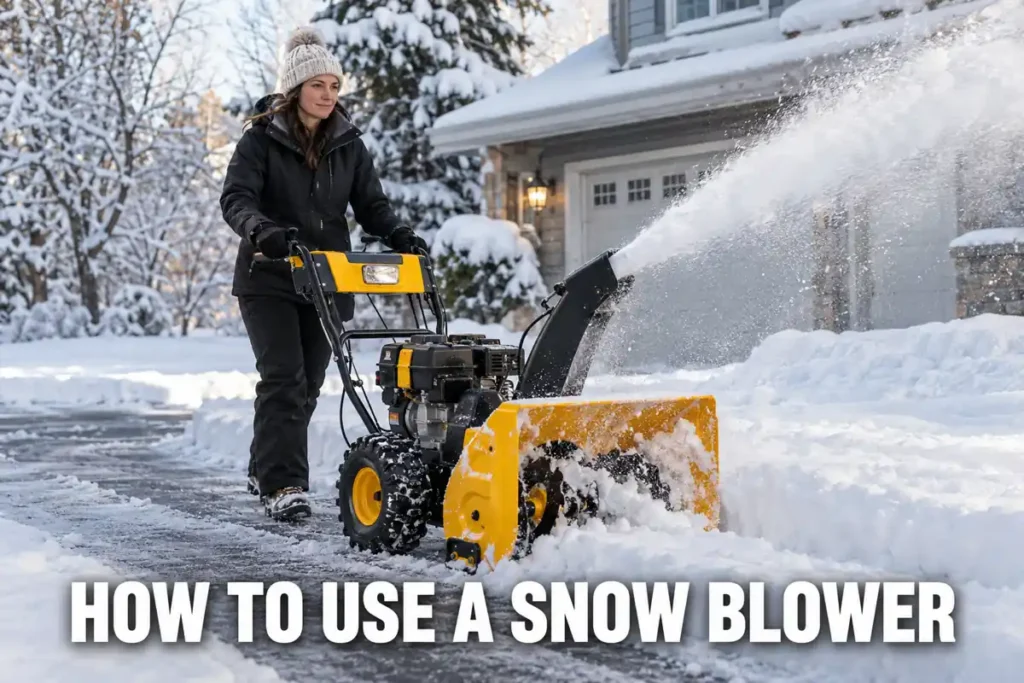
How to use a snow blower comes down to four habits: clear the drive of loose objects first, work in straight overlapping passes at the machine’s own pace, throw the snow downwind and away from people, cars and windows, and never put a hand in the chute. When something clogs, switch off, take away the power (key, plug or every battery pack), wait until every part stops, and use the clean-out tool.
Field work taught me to plan a pass by where it starts, how much it overlaps the last one and where the material lands, and a drive follows the same logic. Below: the pre-checks, pass patterns for calm air and wind, the plow ridge and the shutdown routine.
How to Use a Snow Blower: The Short Routine
The whole job fits in eight steps, and a section below gives the reason for each. Read your manual first: the start sequence, the clean-out wait and the slope limits differ by maker. Start sequences for each power type are on a separate page about how to start a snow blower.
- Walk the area. Pick up doormats, boards, hoses and stones.
- Set the machine. On a two-stage machine, set the skid shoes for your surface, and look for ice in the chute and around the auger.
- Aim the chute and start. Start as your manual describes, with the auger disengaged when not clearing. Machines that refuse to turn over get their own page on a snow blower that won’t start.
- Work in straight, overlapping passes. Start in the middle in calm air, on the upwind edge in wind.
- Throw downwind. Never into a wall, a car or a window.
- Take deep snow in layers below the intake height, with the battery setup your manual specifies. EGO calls for two packs in deep snow. Depth limits by machine type are on my page about what snow a blower handles.
- Switch off before you touch anything. Release the controls, take away the power (key, plug or every battery pack), wait as your manual says, then use the clean-out tool.
- Run it dry. Outdoors, with the chute aimed at open ground, run the auger a few minutes after the last pass, then shut down fully.
Before You Start: Check the Machine, the Drive and the Weather
The first lesson comes before the motor runs: trouble starts with something hidden under the snow or frozen inside the machine. A walk around the drive and a look at the machine remove the common causes.
Walk the Area and Check the Machine
According to EGO, the area must be free of stones, sticks, wires, gravel and other objects the machine could throw, and doormats, sleds and boards go too. I walk the drive the evening before a forecast storm and pick up the doormat at the house door, the boards by the tool shed and the hose near the pump head.
EGO says never to run the unit with frozen parts, and Ariens says to thaw a gas model in a warm area if the recoil handle will not pull. Adjust the skid shoes where your machine has them, as the manual directs. Where the manual allows gravel, as the Toro and Ariens two-stage manuals do, lower the shoes so the scraper bar and auger housing rise above the stones. Toro says its single-stage machines are not for unpaved surfaces, and Greenworks and DeWalt say not to use theirs on graveled surfaces. Lawn use gets its own page, on using a snow blower on grass.
Power, Clothing and Bystanders
Starting differs by model, so follow your manual. A gas machine is fueled outdoors on a cool engine. Cold costs a battery machine output: lithium-ion cells deliver less energy and power at low temperatures (1), and EGO says its machine may not start when the pack is at -4 F or lower. I charge both packs the night before a forecast storm and keep them indoors until I start, so both go in warm.
Wear safety glasses, long pants and boots with a grip, as the EGO and Toro manuals list, and wear hearing protection whatever the power source, because Toro lists it for its battery model. Never run the machine without good visibility or light. People and pets stay out of the discharge path and beyond the distance in your manual.
| Maker | Distance in the manual |
|---|---|
| EGO | At least 100 ft |
| DeWalt | At least 75 ft |
| Milwaukee | At least 50 ft |
How to Snow Blow a Driveway: Pass Patterns and Overlap
Toro says to overlap each swath so no strip of snow stays behind. I pick the first pass by the wind and the pile site, and each pattern below comes with its reason so you can adapt it to your drive.
Start in the Middle in Calm Air
I make the first pass down the middle of the drive and throw to the nearer side. Each following pass moves outward, so the chute stays on one side for each half of the drive and the snow is handled once. On the 40 by 30 foot concrete pad in front of the machinery shed, I run the passes along the 40 foot length.
Start on the Upwind Edge in Wind
In wind I do not start in the middle. I start on the upwind edge and throw downwind, then work across the drive away from the wind. Snow should reach the pile site where it can, but with a limited throw, early passes land on ground I still have to clear, and I accept moving that snow again rather than bury a strip I already cleared. A strong southeast wind once sent a pass straight back at me, so I turned the chute with the wind and moved to the upwind edge.
How Much Overlap and What It Costs
A machine cuts a straight band and drifts a little, so overlap covers the strip between passes. I keep it to a few inches: too little leaves a ridge between passes, and too much adds passes. The 3 inches in the table is only an example I chose.
| Job | Cut and overlap | Passes | Distance walked |
|---|---|---|---|
| Pad, 30 ft wide, 40 ft long | 24 in cut, no overlap | 15 | 600 ft |
| Pad, 30 ft wide, 40 ft long | 24 in cut, 3 in overlap | 17 | 680 ft |
| Drive, 12 ft wide, 150 ft long | 24 in cut, 3 in overlap | 7 | 1,050 ft |
| Drive, 12 ft wide, 150 ft long | 21 in cut, 3 in overlap | 8 | 1,200 ft |
Three inches of overlap adds 2 passes and 80 feet of walking on the pad, about 13% more. On the 150 foot drive, a 21 inch cut walks about 14% farther than a 24 inch cut. You can count passes before the storm arrives; minutes depend on the snow and your pace. My page on how to pick the snow blower size you need matches cut width to the drive.
Match Pace and Layers to the Machine
Toro says to let the machine work at its own pace, and EGO warns against overloading it. An overloaded EGO auger motor slows and its sound drops: slow down or narrow the cut.
The housing takes in only as much snow as its intake is tall: 13 inches on the EGO SNT2130 single-stage, 21 inches on the 28 inch SNT2800 two-stage. Intake height alone does not set what a machine can clear. According to EGO, one pack is only for snow up to 3 inches on the SNT2130 and 8 inches on the SNT2800, and never for very wet or icy snow. Deeper snow goes in layers with two packs installed, each layer below the intake height. Where the two-stage design fits, and where it does not, is on my page about a two-stage snow blower.
How to Snow Blow a Long Driveway
On a long drive I decide the pile site and the throw side before the first pass, then work in sections so the snow goes to the pile site and never back onto a section I have cleared. Where the wind or the throw distance forces a pass onto uncleared ground, I take that snow again on the next pass. On the farm road after a wet snow I start at the shed and work out toward the gate. When I still get a short throw with the wind behind me, I start with the checks in my guide to a snow blower not throwing far.
Wind, Chute Direction and Where the Snow Lands
Where the snow lands decides how much cleanup follows, so I set the chute before the pass and never during it. Throw downwind or across the wind, as EGO and Toro say, and never against a wall or an obstruction. Toro and Milwaukee both warn that the material may ricochet back toward the operator. Matching the throw to the drive is on my page about how far to throw snow.
Check the Throw Path
Before every pass, look along the chute line for people, pets, cars, windows and electrical devices. EGO says to keep discharge pointed away from electrical devices.
Plan the pile site before you start. Snow from the pad goes to the gravel edge and the open grass strip, never against a young tree, the pump-head shelter or a drip line. A pile by the shed door once melted toward the door and froze overnight, so I moved it to the ditch side.
Clearing the Plow Ridge at the End of the Driveway
The ridge a street plow leaves across the end of the drive is packed, often icy and often taller than the 12 to 13 inch intake of a single-stage snow blower. Take it in layers and at a slow walk.
I take the ridge at the gate top first, then the base, and I keep the bites small. Solid ice is shovel work, so I break the crust and any blocks loose before the machine touches the ridge. Blocks of ice can stall the auger or break the shear pins on machines built with them, and a stall means the shutdown routine below comes before you look at anything.
Snow Blower Safety Tips for Every Clearing Run
In US emergency-department data from 2003 to 2018, a hand placed into the chute was the most common recorded injury mechanism, at 44.5% (2). The shutdown routine below is the step that cannot bend.
The Four-Step Clean-Out Routine
According to EGO, hands coming into contact with the rotating auger inside the chute are the most common cause of injury with snow blowers. In a national emergency-room sample of hand injuries from clearing a clogged snow blower, about 22% were amputations (3). How the auger, impeller and chute work together is on my page about how a snow blower works.
- Release the controls and stop the machine. On a gas model, switch off the engine and remove the key.
- Take the power away. Unplug a corded machine. On a battery machine, remove the start key where there is one and take out every battery pack.
- Wait for every part to stop. EGO says to wait 10 seconds, and other makers say to wait until every moving part has stopped. Follow the wait in your manual.
- Clear the chute with the clean-out tool. Toro says to use a stick or a clean-out tool, and EGO says not to use your hand. If your kit has no tool, use a stick.
A Switch Is Not Enough
A released trigger, a lock or an off switch does not replace removing the key and every battery pack. EGO says the auger keeps rotating for a few seconds after the machine is turned off.
When wet snow packed my chute, I let go of the controls, switched off, took out every battery pack, waited until every part had stopped and cleared it with a stick. A hand never goes in the chute, however slow the auger looks. I cover wet snow, pace and worn parts in my answer to why does my snow blower keep clogging.
Eyes, Ears, Footing and Fumes
A US study of lawnmower eye injuries found that 77% came from projectiles such as grass, dirt and rocks, and only 2% of those documented eye protection (4). A chute throws gravel and ice the same way, so I wear safety glasses on every run, including with a battery machine. NIOSH recommends limiting noise to 85 dBA over an eight-hour workday and halving the time for every 3 dBA above that (5), and Toro lists hearing protection even for its battery model, so I wear it on every run, whatever the power source.
- Footing: EGO and Toro both say to keep a firm hold on the handles and to walk, never run. Slips and falls were 13.3% of the injury mechanisms in the same data (2).
- Slopes: EGO says not to operate on grades steeper than 10%, and Milwaukee sets 15 degrees. Both say to work across the grade.
- Reversing: Milwaukee says to stop the auger before backing up, and not to pull the machine backward unless necessary.
- Gravel crossings: Toro says to stop the machine when crossing gravel, and DeWalt says to disengage the auger. Crossing gravel is not clearing it, which my page on using a snow blower on gravel explains by maker.
Gas Engines Run Outdoors Only
A gas snow blower starts and runs outdoors only, never in a garage or shed, even with the door open. In one Seattle series, 29 of 37 portable generator poisoning incidents involved a generator run in the home, most often in the garage (6). That study covers generators, and a snow blower engine is a small gasoline engine too.
After the Run: Shut Down and Prevent Freeze-Up
Melted snow that refreezes inside the machine can lock the auger, the wheels or the chute, so the last job of a run is to get the water out.
- Run it dry. Outdoors, stand behind the handles with the chute aimed at open ground, away from people, cars and windows, and run the auger a few more minutes so moving parts do not freeze, as EGO and Toro say.
- Free the chute and deflector first. While the machine is still powered and you stand at the handles, turn the chute left and right and move the deflector, using the electronic chute controls on models that have them, as your manual describes.
- Shut down fully, then clean. Release the controls, switch off, take away the power (key, plug or every battery pack) and wait until every part has stopped. Then clear ice from the base of the chute with the clean-out tool, never a hand, and wipe the machine. DeWalt and Milwaukee say not to wash the machine with water or a hose.
- Take the packs indoors. Greenworks and Toro say to keep battery packs and chargers indoors in winter. Typical charge times are on my page covering how long it takes to charge a snow blower battery.
Start Slow on the First Storm, Then Build a Routine
Overlap each pass, throw downwind, and shut everything off and wait before a tool goes near the chute. Snow is sporadic where I farm, so every storm feels like a first run, and I walk the drive and set the skid shoes before the first flakes fall. When the season ends, I cover storing a snow blower step by step on its own page.
Of all the snow blower tips I can give, the one I rely on most is to rehearse the shutdown routine on a dry day with the clean-out tool in your hand. If you are still choosing a machine, our snow removal tools pages cover that. Know how to use a snow blower before the first storm: walk the drive, pick up what lies on it and check the packs.
Frequently Asked Questions
How to use a snow blower on a driveway?
To use a snow blower on a driveway, clear loose objects first, aim the chute downwind, make the first pass down the middle in calm air or along the upwind edge in wind, and overlap each pass by a few inches. Keep the auger disengaged until you are ready to move.
How to use a snow blower for the first time?
To use a snow blower for the first time, read the start and shutdown pages of your manual, walk the area for objects, and spend the first run on a short, level stretch at a low speed. Practice stopping, taking away the power, waiting and using the clean-out tool once on a dry day.
How much snow before using a snowblower?
There is no minimum depth that fits every model and surface, so work within the snow limits in your manual. Toro advises clearing snow as soon as possible after it falls, and snow deeper than the machine’s intake height goes in layers.
How long does it take to snow blow a driveway?
How long it takes to snow blow a driveway depends on the number of passes, the length of each pass and your pace. Count the first pass as one cut, divide the rest of the width by the cut minus the overlap, round up, then multiply the passes by the length to get the distance you walk. Deep or wet snow, layers and clogs add time.
How hard is it to use a snow blower?
A snow blower is easy to learn on a dry, level drive, because the controls are few and the machine does the lifting. The hard parts are keeping to the machine’s pace in heavy snow, holding your footing on ice and slopes, and following the shutdown routine every time something clogs.
References
- Ji Y, Zhang Y, Wang C-Y. Li-Ion Cell Operation at Low Temperatures. J Electrochem Soc. 2013;160(4):A636-A649.
- Loder RT, Solanki D. Events Due to Snowblower Use Seen in US Emergency Departments From 2003 Through 2018. Cureus. 2020;12(12):e11836.
- Hammig B, Jones C. Hand injuries associated with reaching into a snow blower to clear clogged snow. Am J Emerg Med. 2020;38(4):785-788.
- Stange NR, Jennissen CA. Lawnmower-Related Eye Injuries in the U.S., 2004 to 2023. Am J Ophthalmol. 2025;277:7-16.
- National Institute for Occupational Safety and Health. Noise-Induced Hearing Loss. Noise and Hearing Loss. Centers for Disease Control and Prevention; 2024.
- Hampson NB, Zmaeff JL. Carbon monoxide poisoning from portable electric generators. Am J Prev Med. 2005;28(1):123-125.
Safety Note: Snow blowers throw snow, ice and hidden objects with force. Never reach into a clogged chute or auger. Shut the machine off first: stop the engine on a gas model, unplug a corded model, or remove the safety key and every battery pack from a battery model. Wait at least as long as your manual says, often 10 seconds, and until every moving part has stopped, then remove the key and disconnect the spark plug wire where your manual says so, and clear the clog with the clearing tool. Keep people and pets out of the discharge path, run gas models outdoors only, and read the manufacturer’s manual.