
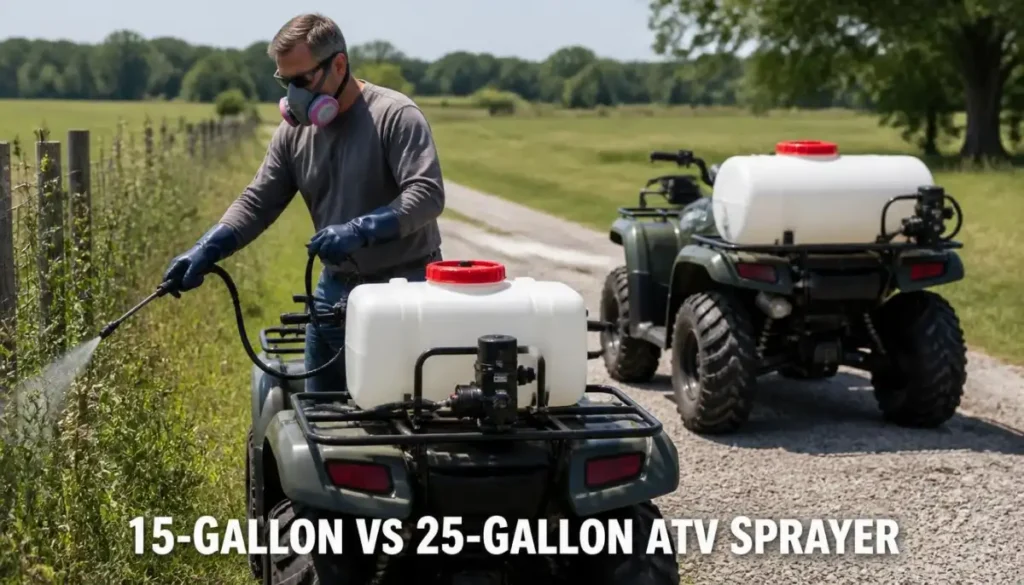
The 15 gallon vs 25 gallon ATV sprayer choice comes down to one number: what your vehicle’s owner’s manual lets the rack carry. Clean water weighs about 8.3 pounds a gallon, so a full 15 gallon tank holds about 125 pounds of liquid and a full 25 gallon tank about 208 pounds, before the tank, pump and wand. My plant protection training taught me to read the limit on the carrier before the spec on the sprayer. Below are the weight arithmetic, one manual’s rack limits as an example, how sloshing liquid changes handling, what the makers print for each size and a safe fill routine.
15 Gallon vs 25 Gallon ATV Sprayer at a Glance
Pick the 15 gallon tank when your rack limit leaves little spare weight, and pick the 25 gallon tank only when your vehicle’s manual allows the full load with room to spare. The bigger tank gives 10 more gallons per fill and puts about 83 more pounds of liquid on the same vehicle. Nearly every other difference follows from that weight.
Tank size also travels with the pump. Master Mfg prints 1.0 GPM and up to 40 PSI for its 15 gallon spot sprayer and 2.2 GPM and up to 70 PSI for its 25 gallon Deluxe, and both are the maker’s ceilings rather than working settings. I go through that 15 gallon unit’s pump, tank and fittings in my Master Manufacturing sprayer review.
| Row | 15 gallon | 25 gallon |
|---|---|---|
| Tank capacity | 15 gallons | 25 gallons |
| Clean water in a full tank, about | 125 lb | 208 lb |
| Pump flow, maker’s figure | 1.0 GPM | 2.2 GPM |
| Pressure ceiling, maker’s figure | Up to 40 PSI | Up to 70 PSI |
| Tank lid, maker’s parts list | 5 in | 5 in |
| Warranty, maker’s manual | Two years, replacement parts only | Two years, replacement parts only |
What Each Tank Weighs When Full
An ATV tank sprayer is a load of liquid before it is anything else, and clean water sets the baseline. The arithmetic takes four lines.
The Arithmetic
The USGS Water Science School gives the density of water as 62.3 pounds per cubic foot at 70 degrees Fahrenheit. A US gallon holds 231 cubic inches, which is 0.1337 cubic foot, so one gallon of clean water weighs about 8.3 pounds. Multiply that by the tank size and you get about 125 pounds for 15 gallons and about 208 pounds for 25 gallons.
| Gallons in the tank | Clean water, about |
|---|---|
| 5 gallons | 42 lb |
| 10 gallons | 83 lb |
| 15 gallons | 125 lb |
| 20 gallons | 167 lb |
| 25 gallons | 208 lb |
The table shows what a part fill does. A 25 gallon tank filled to 15 gallons carries the same 125 pounds of water as a full 15 gallon tank, Weigh your exact sprayer, with its hose, wand and mounting hardware, on one stated basis before you compare it with any limit.
What the Figure Leaves Out
These figures are for clean water. The tank, pump, hose, wand and wiring add weight on top, and a product mixed into the water changes the total, so treat 125 and 208 pounds as the water baseline and not as the full load. Weigh the empty sprayer with its hose and wand first and add it to the water figure before you read any rack limit.
Your Vehicle Manual Sets the Limit
The sprayer’s label tells you the tank size. The vehicle’s owner’s manual tells you what the racks can carry, and that manual is the only place the limit lives. According to Chapin’s manual for the 97200E, the sprayer is designed to be attached to stable surfaces, so the rack, the straps and the mounting kit are yours to size. My comparison of Chapin’s two sprayer sizes sets the 97200E beside the 25 gallon 97254.
What Polaris Tells Owners
Polaris’s 2022 Sportsman 570 owner’s manual tells owners never to exceed the weight capacities on the warning labels and in the specifications section. It says to carry loads as low on the racks as possible, to put roughly one-third of the cargo on the front rack and two-thirds on the rear, and that heavy loads can cause braking and control problems. In a second Sportsman 570 manual, Polaris adds that the operator, accessories, cargo and hitch weight together must stay within the vehicle’s maximum weight capacity.
A spot sprayer sits on one rack, so all of its liquid loads that rack at once. Add the water weight to the empty sprayer and compare the sum with the limits in your own manual, on its warning labels and in its specifications section. I check the rack the sprayer will sit on and the vehicle’s total, and I pick the 15 gallon tank whenever the water and the empty sprayer together sit near that limit. My guide to picking the ATV sprayer size you need walks through tank size, rack load and surge.
Sloshing Liquid, Baffles and Slopes
Weight is one problem and movement is the other. I treat a tank of liquid on a rack as a moving load and plan for it that way. Montana State University Extension says that sloshing liquid in enough quantity can change how an ATV handles, and the 25 gallon tank puts about 83 more pounds of liquid in motion than the 15 gallon tank.
Load, Surge and Slopes
Stay within the rack and tow capacity in your vehicle’s owner’s manual. Sloshing liquid shifts weight and changes how the vehicle handles: Montana State University Extension advises a spray tank with internal baffles and the lowest practical center of gravity, a boom that works as low to the ground as possible, and a rear-mounted boom or equipment that lowers the operator’s exposure. On an ATV, follow its manual and your hands-on training for body position and for the slopes it permits with a sprayer load; Montana State’s advice for ATVs on a hill is to lean your body uphill, and body position does not guarantee protection against a rollover. In a UTV, stay properly restrained inside the vehicle and follow its manual’s slope limits. Research on ATV injuries has linked uphill travel to backward rollovers (1).
Baffles and Center of Gravity
Baffles are internal walls in the tank that slow the liquid down. Montana State says they reduce liquid surges and improve stability when turning on slopes or hills. I look for internal baffles before anything else on a tank’s spec sheet, because the extension advice asks for them and a bigger tank has more liquid to surge. The units in this article come with maker figures for tank size, pump and pressure, and baffles are not among the figures the makers print.
Wand, Boom and Speed
A 15 or 25 gallon spot sprayer comes with a hand wand, and the wand sets the riding rule. Montana State University Extension advises not to ride and spray if you have to hold a wand or lance. My rule for any vehicle unit is that the vehicle stops and is secured before a hand wand comes out. Montana State also says to use only the speed you need, and notes that a good spray distribution probably calls for a speed slower than you would like.
Riding Rules
Wear the helmet and other protective gear the Consumer Product Safety Commission recommends, get hands-on training from a qualified instructor, and sit only in the positions the manufacturer designed for occupants. The CPSC says never to ride with more passengers than there are seats. In a UTV, fasten the seat belts and keep every part of your body inside the vehicle as its manual directs. The CPSC says riders younger than 16 should drive only age-appropriate youth model ATVs, never adult ATVs, and that off-road vehicles are designed for off-road terrain, not paved surfaces. Most ATVs seat one rider.
What the Makers Print for Each Size
Four 12 volt units show how a 25 gallon sprayer for ATV use differs from a 15 gallon one on paper. All of them run from a vehicle battery and none carries a battery of its own.
15 Gallon ATV Sprayer Examples
According to Chapin’s manual, the 97200E runs on 12 volts from a vehicle battery through a harness with an in-line fuse, uses a two chamber diaphragm pump, and its pressure switch shuts the pump off at 60 PSI. Chapin also says pressure can only be adjusted by adjusting the nozzle. Chapin lists a 6 inch tank opening and an 18 inch wand, and its manual gives a 7.5 amp replacement fuse. I put the 97200E next to Master Manufacturing’s 15 gallon unit in my Chapin and Master Manufacturing sprayers comparison.
Master Mfg’s 15 gallon spot sprayer uses an Everflo 12 volt on-demand diaphragm pump rated 1.0 GPM with a printed maximum of 40 PSI, a spray gun with a trigger lock and a 5 inch tank lid. The maker’s manual covers the whole 12 volt spot sprayer family and gives the same two-year warranty on replacement parts for this size and the next.
25 Gallon ATV Sprayer Examples
Master Mfg’s 25 gallon Deluxe carries a 2.2 GPM Everflo pump with a printed maximum of 70 PSI, a 10 foot harness with alligator clamps and a 15 foot hose. According to Master Mfg, molded-in inserts at the base of the tank take a Master Mfg mounting kit, which is sold separately. Chapin’s listing for its 97254 25 gallon unit prints a diaphragm pump with a maximum pressure of 60 PSI. I set that 97254 against the Master Mfg Deluxe in my head-to-head on the 25 gallon spot sprayer.
A printed pump ceiling is easy to read as a target. A 25 gallon tank with a 70 PSI ceiling does not make 70 PSI a setting.
Pressure Is a Ceiling
A sprayer’s maximum pressure is the limit of the machine, not a setting to aim for. The product label and the nozzle’s maker decide the pressure and the nozzle for a job. Higher pressure makes more fine droplets that drift, and the nozzle you choose changes the droplet size. My answer to “what does PSI mean on a sprayer” explains pressure ranges and limits in plain words.
Nuyttens and colleagues measured droplet size and velocity for 32 nozzle and pressure combinations on a test rig for agricultural boom nozzles. They found that nozzle type, size and pressure all change the droplet size spectrum (2).
Filling, Rinsing and Storing the Tank Safely
Every refill is hands-on work at the tank, the pump or the harness, and I do the shutdown first every time. A 25 gallon tank means fewer refills per job, because two 15 gallon fills carry 30 gallons against 25 in one fill, and each refill starts with the same shutdown.
Emergency First
If a battery becomes unusually hot, swells, hisses, gives off an unusual odor or smokes, stop using the sprayer without handling or removing the battery, keep people away and follow the battery manual’s emergency instructions; if it smokes, burns or presents immediate danger, move away and call 911 or the fire department without finishing the routine shutdown.
Full Shutdown Box
Shutdown before you open the tank, fill or refill it, change or clean a nozzle, clear a clogged nozzle, clean or rinse the sprayer, adjust or repair anything, move, store or leave the sprayer. Never point the wand at yourself, another person or a pet. During normal spraying, move only as the equipment manuals and the product label permit; walking while spraying with a backpack unit, or driving a mounted boom at the spraying speed its manual describes, is operation, not transport. Never ride while operating a hand-held wand or lance.
12V Vehicle Sprayer Shutdown
12V vehicle sprayer (ATV, UTV, cart or tow-behind): first stop and secure the vehicle as its manual directs. Then release the trigger, close the wand or boom valve and switch the pump off at its switch. Relieve all trapped pressure using only your exact manual’s procedure and a discharge destination consistent with the product label, without opening the tank or loosening any part beforehand unless that procedure expressly requires it, and never toward yourself, another person or an animal. Then disconnect the pump’s 12V supply at the connection your manual specifies. Reconnect it only after the work is complete, every part is secured and the pump switch is off.
Protective Equipment and Leaks
Wear the protective equipment the product label requires while you clean the tank, the strainer or a nozzle. Clear a clogged nozzle only with the method in your exact manual; never clear a nozzle with your mouth and never by blowing into it. Add every step your manual gives, in its order. Refit every part, close the lid and check for leaks with clean water before product goes back in.
Master Mfg’s manual adds its own order for the 15 and 25 gallon units: before filling the tank, make sure power to the sprayer and the vehicle is off and the brakes are set, and before leaving the sprayer, turn off the vehicle, set the brake or block the wheels, turn off power to the sprayer and relieve system pressure. It describes relieving pressure by disconnecting power and squeezing the gun trigger, so do that toward a place the product label allows and away from every person and pet. Chapin’s 97200E manual prints no pressure-relief procedure, and if your exact manual gives none, obtain the manufacturer’s guidance before you open the tank or loosen any part.
First Water Fill
Before the first water test, complete the full shutdown in the shutdown box above, then fill the tank with clean water and close the lid as your manual directs. Connect the 12 volt supply only when you are ready to test. Run the sprayer and watch the wand, hose, fittings and tank seams for leaks without touching pressurized parts. Before you open the tank, correct a leak or add product, complete the full shutdown again.
Master Mfg’s manual for its 15 and 25 gallon spot sprayers says to test with fresh water before adding and spraying chemicals, and to test for leaks with water one final time after any repair. Before every use, complete the full shutdown in the shutdown box above, then check the tank, strainer, hose and nozzle, and fix any leak before product goes in. I fill with clean water first and watch the hose clamps, the drain cap and the pump head for drips.
Wiring the 12 Volt Pump
Before any wiring work on the pump, complete the full shutdown in the shutdown box above, including its emergency exception and securing the vehicle. Wire the pump the way your sprayer’s manual says, and use the fuse the manual lists. To disconnect the supply, follow the shutdown box through securing the vehicle, stopping the pump and relieving the pressure, then disconnect it as your manual directs; reconnect it only after the work is complete, every part is secured and the pump switch is off.
Master Mfg’s manual says to connect the red clamp to the battery’s positive post and the black clamp to the negative post, and warns that opposite posts make the pump run backwards. Chapin’s manual warns that a pinched or damaged harness can overheat and cause a meltdown or fire. I route the harness away from the rack edge and every moving part.
Label, Protective Equipment and Mixing
Before you open a product container, read the label. The label is the law, and the sprayer’s manual answers only for the machine.
The Product Label
The product label is the law. It tells you what protective equipment to wear, how and where you may use the product, what weather it allows, how long to stay out of the treated area, how long to wait before you harvest, how to protect bees and other pollinators, and how to dispose of leftover product and the empty container. Using a registered pesticide in a way its label does not allow is against federal law. Your sprayer’s manual does not replace the label, and the label does not replace the manual: read the label before you open the container, and follow both.
Protective Equipment
Wear the protective clothing and equipment the product label requires, and put it on before you open the container. Wear the eye protection and gloves the label names every time you mix, load, spray, clean the tank or clear a nozzle. Cornell’s pesticide safety program also advises chemical-resistant gloves, goggles and a respirator when you handle moderately toxic products, even when the label does not call for them. Wear every respirator the label requires, of the type the label names, and follow the respirator maker’s instructions for fit, use and care. If you follow Cornell’s advice and wear one the label does not require, or if it is unclear which respirator or filter is right, get qualified guidance on the respirator and filter before you handle the product. Protective equipment lowers your exposure; it does not make spraying safe.
According to Chapin’s manual for the 97200E, always wear goggles, gloves, a long sleeve shirt, long pants and full foot protection when spraying, in addition to anything the product label requires.
A critical review of the research on agricultural pesticide users found that the real-world effectiveness of protective equipment may be over-estimated (3). A systematic review of 121 articles on agricultural pesticide handlers found that goggles and gloves were worn less often than long sleeves and trousers (4).
Amounts and Mixing
The product label, not this page, gives the amount of product, the dilution and the mixing order, so read it before you mix. Do not combine products unless the mixture complies with every product’s label and its compatibility has been established through the manufacturers or a qualified pesticide specialist; nobody’s advice overrides a label prohibition.
Mixing and Loading
Before you load the sprayer, complete the applicable full shutdown in the shutdown box, including its emergency exception, and wear the protective equipment the product label and your manual require for the task. Mix and load outdoors, away from other people (including children), pets and livestock, and where a spill or overflow cannot reach a well, a drain or other water. Read the label before you open the container, stand upwind, and do not eat, drink or smoke while you handle pesticides. Never use your mouth to siphon a pesticide from its container. Keep the fill hose above the level of the liquid in the tank so the product cannot siphon back into your water supply, and never leave the sprayer unattended while you fill it. Use measuring tools kept only for pesticides, never kitchen utensils or food containers. Mix only as much as the job needs so the tank ends empty; do not store leftover mix in the sprayer for later, because it can damage the sprayer’s parts.
Rinsing and Storage
Before you drain, flush or clean anything, complete the applicable full shutdown in the shutdown box above, including its emergency exception. Chapin’s manual says to flush the pump with water after every use and never to leave solution in the tank, and Master Mfg’s manual says not to store the sprayer with chemicals in the tank. The product label and your model’s manual decide how you drain, flush and dispose of rinse water.
Cleaning
Before you clean the sprayer, complete the applicable full shutdown in the shutdown box, including its emergency exception, and wear the protective equipment the label and your manual require. Clean the sprayer as soon as you can after use, because dried product is harder to remove than product still in solution. Empty the tank, rinse the tank, hose, wand and nozzle, and clean the strainers and screens, following the product label and your manual; extension guidance warns that water alone may not remove every product. Clean it away from desirable plants, wells and other water, and wash the outside. Do not pour leftover product or rinse water down a sink, a toilet or a storm drain, or onto bare ground.
Storage
Before you store the sprayer, complete the applicable full shutdown in the shutdown box, including its emergency exception. Store pesticides in their original containers, with the label on, locked up or under the control of a person who can keep others away, and out of the reach of children. Never put a pesticide in a container used for food, drink or household products. Keep pesticides away from food, animal feed and protective equipment, and store pesticides and fertilizers apart, because they can react with each other and start a fire. Store the sprayer drained, cleaned and dry, as your manual describes.
Exposure
If someone is exposed to a pesticide, follow the first-aid section of the product label and call Poison Control (America’s Poison Centers) at 1-800-222-1222, and keep the product label with you. Call 911 in an emergency.
Which Tank Size to Choose
The rack limit picks the size. The lists below turn the weight figures into a decision, and your own owner’s manual sets the limits. My guide on the backpack sprayer vs ATV sprayer shows what changes when a vehicle carries the tank instead of your back.
Choose the 15 Gallon Tank If
- The rack limit is tight: the water alone is about 125 pounds, and the empty sprayer comes on top.
- You want less liquid to carry: the 15 gallon tank holds about 83 fewer pounds of water, and Montana State advises the lowest practical center of gravity and internal baffles whichever size you buy.
- Your manual lists only a front rack or a small rear rack: check that rack’s limit against about 125 pounds of water plus the empty sprayer.
Choose the 25 Gallon Tank If
- Your manual shows room for about 208 pounds of water plus the empty sprayer: that is the full-tank load on the rack you will use.
- You want 10 more gallons per fill: a refill takes the full shutdown each time, and the larger tank cuts the number of refills.
- The tank you buy has internal baffles: Montana State advises them for stability when turning on slopes or hills.
Skip the 25 gallon tank if the rack limit is below about 208 pounds plus the empty sprayer. Skip both if the work needs a hand wand held while the vehicle moves. A mistake to avoid is choosing the tank by the number on its lid and reading the rack limit last. My ATV guide to 25 and 40 gallon sprayers shows what the bigger tank adds and what it asks of the vehicle.
Before You Buy Either Tank
Remember three things: clean water weighs about 8.3 pounds a gallon, the vehicle manual’s rack limit decides, and sloshing liquid shifts the load and changes handling. My recommendation is to start with the 15 gallon tank and move to 25 gallons only when the manual shows the room. One more tip: write the rack limit and the full-tank water weight on a card and keep it beside the sprayer in the shed. Read the load pages in your own vehicle’s manual next. Match the tank to what both manuals allow, and the 15 gallon vs 25 gallon ATV sprayer question becomes a matter of your vehicle’s limits, fill levels and mounting. If you are still choosing a unit, my roundup of the best ATV spot sprayer compares five 12 volt models on tank, pump and hose specs.
Frequently Asked Questions
What is the difference between a 15 gallon and a 25 gallon ATV sprayer?
The difference between a 15 gallon and a 25 gallon ATV sprayer is 10 gallons of tank, about 83 pounds more clean water per fill, and different pump figures on Master Mfg’s two models. Master Mfg prints 1.0 GPM and up to 40 PSI for its 15 gallon unit and 2.2 GPM and up to 70 PSI for its 25 gallon Deluxe. The extra weight is what your vehicle’s rack limit has to carry.
Is a 25 gallon ATV sprayer too heavy for an ATV?
A 25 gallon ATV sprayer is too heavy for an ATV when a full tank plus the empty sprayer goes past the rack limit in that vehicle’s owner’s manual. Clean water in the tank alone is about 208 pounds, before the tank, pump and wand. Your vehicle’s owner’s manual sets the limit, so read its rack and total-load figures before you buy.
Is a 15 gallon ATV sprayer big enough?
A 15 gallon ATV sprayer is big enough when the job fits in 15 gallons of liquid per fill and refills are acceptable. The tank holds about 125 pounds of clean water, which is also the easier load for a rack. Before each refill, complete the full shutdown for your sprayer in the shutdown box above.
Does a bigger ATV sprayer tank make the ATV less stable?
A bigger ATV sprayer tank can make the ATV less stable, because sloshing liquid shifts weight and changes how the vehicle handles. Montana State University Extension advises a tank with internal baffles and the lowest practical center of gravity. Follow your vehicle’s manual for the slopes it permits with a sprayer load.
Should I choose a 15 gallon or 25 gallon ATV spot sprayer?
Choose a 15 gallon ATV spot sprayer when your rack limit leaves little room above 125 pounds of water plus the empty sprayer, and a 25 gallon unit only when the manual shows room for about 208 pounds plus the empty sprayer. The larger tank gives 10 more gallons per fill and adds about 83 pounds. Your vehicle’s owner’s manual makes the call.
References
- Brandenburg MA, Brown SJ, Archer P, Brandt EN. All-terrain vehicle crash factors and associated injuries in patients presenting to a regional trauma center. J Trauma. 2007;63(5):994-999.
- Nuyttens D, Baetens K, De Schampheleire M, Sonck B. Effect of nozzle type, size and pressure on spray droplet characteristics. Biosyst Eng. 2007;97(3):333-345.
- Garrigou A, Laurent C, Berthet A, et al. Critical review of the role of PPE in the prevention of risks related to agricultural pesticide use. Saf Sci. 2020;123:104527.
- Sapbamrer R, Thammachai A. Factors affecting use of personal protective equipment and pesticide safety practices: a systematic review. Environ Res. 2020;185:109444.
Safety Note: Read your sprayer’s manual and the product label before you open any container. The label is the law: it tells you what protective equipment to wear, how and where you may use the product, what weather it allows, how long to stay out of the treated area, how long to wait before you harvest, how to protect bees and other pollinators, and how to dispose of leftovers and the empty container. Using a registered pesticide in a way its label does not allow is against federal law. This page never gives an amount of product, a dilution or a mixing order: the label does. Wear the protective clothing and equipment the label requires, put it on before you open the container, and wear the eye protection and gloves it names whenever you mix, load, spray, clean the tank or clear a nozzle. Protective equipment lowers your exposure; it does not make spraying safe. Wear every respirator the label requires, of the type it names, and follow the respirator maker’s fit, use and care instructions. Before you clean or store the sprayer, or wire a 12V pump, complete the shutdown below first. Before you mix or load, complete the shutdown below, including its emergency exception. Mix and load outdoors, away from other people (including children), pets and livestock, and where a spill cannot reach a well, a drain or other water. Stand upwind, never use your mouth to siphon a product, keep the fill hose above the liquid so it cannot siphon back into your water supply, and never leave the sprayer unattended while you fill it. Mix only what the job needs, and do not store leftover mix in the sprayer. Never point the wand at yourself, another person or a pet, and never test a spray against your hand. Emergency first: if a battery becomes unusually hot, swells, hisses, gives off an unusual odor or smokes, stop using the sprayer without handling or removing the battery, keep people away and follow the battery manual’s emergency instructions; if it smokes, burns or presents immediate danger, move away and call 911 or the fire department without finishing the routine shutdown. Otherwise, before you open the tank, fill it, change or clean a nozzle, clear a clogged nozzle, clean or rinse the sprayer, adjust or repair anything, charge or change the battery, load, unload, transport, store or leave the sprayer, or lift, put on or take off a backpack unit, complete the shutdown. During normal spraying, move only as your manual and the product label permit, and never ride while operating a hand-held wand or lance. Battery sprayer: release the trigger or close the wand valve, then switch the pump off. Relieve all trapped pressure using only your exact manual’s procedure and a discharge destination consistent with the product label, without opening the tank or loosening any part beforehand unless that procedure expressly requires it, and never toward yourself, another person or an animal. Then remove the battery. 12V vehicle sprayer: first stop and secure the vehicle as its manual directs, then release the trigger, close the wand or boom valve and switch the pump off. Relieve all trapped pressure using only your exact manual’s procedure and a discharge destination consistent with the product label, without opening the tank or loosening any part beforehand unless that procedure expressly requires it, and never toward yourself, another person or an animal. Then disconnect the pump’s 12V supply at the connection your manual specifies, and reconnect it only after the work is complete, every part is secured and the pump switch is off. Wear the label’s protective equipment while you clean the tank, the strainer or a nozzle. Clear a clogged nozzle only with the method in your exact manual, never with your mouth and never by blowing into it. Refit every part and check for leaks with clean water before product goes back in. For the first water test, complete the shutdown first, fill the tank with clean water and close it as your manual directs, connect the power only when you are ready, and watch the wand, hose, fittings and tank seams for leaks without touching pressurized parts; complete the shutdown again before you open the tank, fix a leak or add product. Wind, heat and fine droplets carry spray off target: the label may be stricter than any extension guideline, and extension sources give different wind figures, so no single number fits every situation. Do not spray during a temperature inversion, and do not assume that calm air, early morning or evening is suitable. Do not spray just before rain. Keep children, pets and other people out of the area while you spray and off the treated area for as long as the label says, and remove toys and cover pet food and water dishes first. The label’s pollinator wording decides when you may spray around flowering plants, and early morning or evening is not automatically suitable. A sprayer that has held weed killer should stay a weed-killer sprayer: extension services advise a dedicated sprayer, and rinsing may not remove every residue. Follow the product label’s instructions for rinsing empty containers, handling rinse water and disposing of them, and never reuse an empty pesticide container; for leftover product, call your state pesticide agency or a household hazardous waste program, and never pour it down a sink, a toilet or a storm drain. Store pesticides in their original containers, locked up and out of the reach of children, away from food and animal feed, and keep pesticides and fertilizers apart. If someone is exposed, follow the first-aid section of the label, call Poison Control at 1-800-222-1222 and keep the label with you; call 911 in an emergency. If product spills, keep people and animals away and follow the label’s emergency directions; try to contain a small spill only if the label says that is safe and you have the protective equipment it requires, and otherwise get help (the emergency number on the label, Poison Control if anyone is exposed, 911 for a fire, immediate danger or a large spill). Use only the battery and charger the maker supplies or lists for your exact sprayer, charge and store the battery as your manual describes, and do not use a damaged battery or charger: lithium-ion batteries can overheat and catch fire. Wire a 12V pump the way your manual says and use the fuse it lists. On an ATV or UTV, wear the helmet and protective gear the Consumer Product Safety Commission recommends, get hands-on training, sit only in the positions the manufacturer designed, never ride with more passengers than there are seats, and in a UTV fasten the seat belts and keep every part of your body inside the vehicle; stay within the rack and tow capacity in your vehicle’s owner’s manual, and remember that sloshing liquid shifts weight and changes how the vehicle handles; Montana State University Extension advises against riding and spraying if you have to hold a wand or lance. Stop at once, complete the full shutdown and inspect if the sprayer leaks, loses pressure or runs without spraying, and restart only as the manual allows. If a battery becomes unusually hot, swells, hisses, gives off an unusual odor or smokes, do not handle or remove it: keep people away, follow the battery manual’s emergency instructions, and if it smokes or burns, move away and call 911 or the fire department. Before you fill the tank, complete the shutdown, and fill it only to the level your manual allows. Carrying a full tank is tiring: rest when you are tired.