
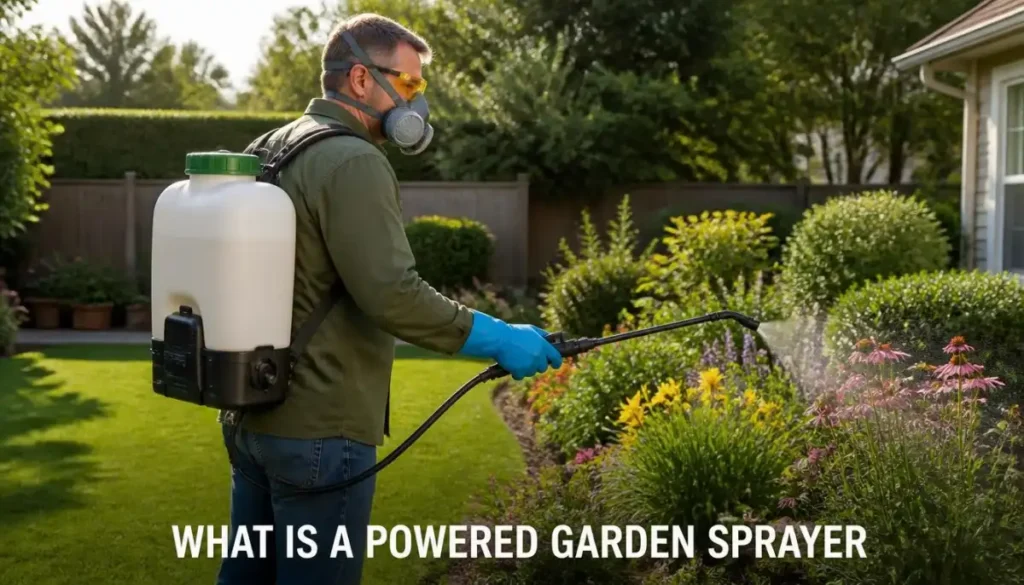
A powered garden sprayer is a tank, a pump and a wand, with a battery or a 12V vehicle supply driving the pump instead of your arm. It sends liquid through a hose and a nozzle, and that liquid is often a pesticide, so the product label sets the rules. I trained in plant protection and spent years around field sprayers, so I read any sprayer by its parts, its power source and its manual first. Below you get the parts, the main classes, the plain terms and the safety order that applies to all of them.
What Is a Powered Garden Sprayer?
A powered garden sprayer holds a liquid in a tank and pushes it out through a hose, a wand and a nozzle with a pump that runs on electricity. The electricity comes from a rechargeable battery on handheld and backpack units, or from the 12V supply of a vehicle on ATV and UTV units. You squeeze a trigger and the pump does the work that a hand-pump sprayer asks of your arm.
The word powered covers a wide range of machines. The PetraTools HD2000-S is a 2-gallon sling sprayer that, according to the maker, runs on a 12V rechargeable battery. The DEWALT DXSP190681 is a 4-gallon unit that its manual calls a lithium-ion powered backpack sprayer, and my DEWALT sprayer review covers the whole kit. The Chapin 97200E is a 15-gallon spot sprayer that, according to its manual, takes 12V from a vehicle battery and has no battery of its own.
Powered describes the pump and nothing else, and a battery powered garden sprayer is no exception. Using a registered pesticide in a way its label does not allow is against federal law, and your sprayer’s manual decides everything about the machine itself. I keep one habit with every sprayer I look at: find the power source first, because it decides how you charge it, how you store it and which safety order applies.
The Parts of a Powered Sprayer
Every powered sprayer is built from the same few parts, and the order for working on them safely is the same too. Before you touch any part, read the shutdown box below: it applies to every hands-on step in this article.
Full Shutdown Box
Emergency first: if a battery becomes unusually hot, swells, hisses, gives off an unusual odor or smokes, stop using the sprayer without handling or removing the battery, keep people away and follow the battery manual’s emergency instructions; if it smokes, burns or presents immediate danger, move away and call 911 or the fire department without finishing the routine shutdown. Shutdown before you open the tank, fill or refill it, change or clean a nozzle, clear a clogged nozzle, clean or rinse the sprayer, adjust or repair anything, charge or change the battery, move, store or leave the sprayer. Never point the wand at yourself, another person or a pet. During normal spraying, move only as the equipment manuals and the product label permit; walking while spraying with a backpack unit, or driving a mounted boom at the spraying speed its manual describes, is operation, not transport. Never ride while operating a hand-held wand or lance. Battery sprayer (handheld or backpack): release the trigger or close the wand valve, then switch the pump off. Relieve all trapped pressure using only your exact manual’s procedure and a discharge destination consistent with the product label, without opening the tank or loosening any part beforehand unless that procedure expressly requires it, and never toward yourself, another person or an animal. Then remove the battery and keep it away from the sprayer. 12V vehicle sprayer (ATV, UTV, cart or tow-behind): first stop and secure the vehicle as its manual directs. Then release the trigger, close the wand or boom valve and switch the pump off at its switch. Relieve all trapped pressure using only your exact manual’s procedure and a discharge destination consistent with the product label, without opening the tank or loosening any part beforehand unless that procedure expressly requires it, and never toward yourself, another person or an animal. Then disconnect the pump’s 12V supply at the connection your manual specifies. Reconnect it only after the work is complete, every part is secured and the pump switch is off. Wear the protective equipment the product label requires while you clean the tank, the strainer or a nozzle. Clear a clogged nozzle only with the method in your exact manual; never clear a nozzle with your mouth and never by blowing into it. Add every step your manual gives, in its order. Refit every part, close the lid and check for leaks with clean water before product goes back in.
If your manual gives no procedure for relieving trapped pressure, obtain manufacturer guidance before opening anything. Where the manual does not say that the battery comes out, ask the maker how to isolate the power before any hands-on work.
NDSU Extension lists the basic components of a farm sprayer as the pump, the tank, an agitation system, a flow-control assembly, a pressure gauge and a distribution system (1). A garden unit does not have to carry all six, and which ones a model has is the maker’s statement for that model.
Tank and Strainer
The tank holds the liquid, and a strainer keeps debris out of the pump and the nozzle. The PetraTools manual lists a filter below the tank lid. The DEWALT manual names a filter basket in the tank opening and an in-tank filter at the bottom of the tank. NDSU calls a plugged nozzle one of the most frustrating problems that applicators experience with sprayers, which is why I look at the tank opening and the strainer before I look at anything else on a new model. My guide on what a spray nozzle is covers types, droplet size and drift basics.
Pump and Power
The pump is the part that the battery or the vehicle supply drives. NDSU names four pump types for farm sprayers: centrifugal, roller or rotary, piston and diaphragm (1). Which one a garden sprayer has is the maker’s statement for that model, and I treat the pump type as a question for the manual, never for the box. The Chapin 97200E manual describes a 2-chamber positive displacement diaphragm pump, while the PetraTools, DEWALT and EGO manuals do not name the pump type.
The power side differs by class. According to EGO, the BSP3500 runs on 56V lithium-ion battery packs and is sold without a battery or a charger. Voltage figures such as 12V, 20V and 56V are each maker’s own label, so I compare models on their printed tank, pressure and battery details and never on voltage alone. My comparison of 12V and 18V battery sprayers sets named models side by side on their printed figures.
Hose, Wand and Nozzle
The hose carries the liquid from the pump to the wand, and the nozzle shapes it into a spray. NDSU says there are only three basic spray patterns: the flat fan, the hollow cone and the full cone (1). According to EGO, the BSP3500 comes with an adjustable nozzle on the wand plus a fan, a shower and a foaming nozzle. The DEWALT manual lists a 21-inch stainless steel wand.
Pressure Controls
NC State Extension says most backpack sprayers have pressure regulators that deliver the spray mix at a constant pressure, and that few handheld sprayers contain one. The DEWALT manual describes a 10-position variable flow dial with a printed nozzle flow chart. According to EGO, the BSP3500 has a maximum working pressure of 350 psi. The Chapin 97200E manual gives a maximum pressure of 60 PSI.
A pressure figure on a spec sheet is the machine’s ceiling, never a setting to aim for. The label and the nozzle’s maker decide the pressure for a job. My guide on what PSI means for sprayers explains pressure ranges and limits.
Before the First Use
Before the first water test, complete the full shutdown in the shutdown box, then fill the tank with clean water and close the lid as your manual directs. Connect the power (install the battery or connect the 12V supply) only when you are ready to test. Run the sprayer and watch the wand, hose, fittings and tank seams for leaks without touching pressurized parts. Before you open the tank, correct a leak or add product, complete the full shutdown again. Before every use, check the tank, strainer, hose and nozzle, and fix any leak before product goes in. Follow your manual’s first-use steps.
The Classes of Powered Sprayers
Powered sprayers fall into a few classes by how you carry them and what powers the pump. I sort them with two questions: does a person carry it or does a vehicle carry it, and does a battery or a vehicle supply drive the pump.
| Class | Carried by | Power | Example and tank as printed |
|---|---|---|---|
| Battery handheld | Shoulder strap | Battery | PetraTools HD2000-S, 2 gallon (maker’s page) |
| Battery backpack | Shoulder straps | Battery | DEWALT DXSP190681, 4 gallon (manual); EGO BSP3500, 4 gallon (manual) |
| 12V spot sprayer | Vehicle, as the manuals direct | 12V vehicle supply | Chapin 97200E, 15 gallon (manual) |
| Boom, boomless, tow-behind | Vehicle carries or tows | Per the exact model | Read the exact model’s manual |
Battery Handheld Sprayers
A handheld garden sprayer is the smallest class, and I never judge one by its tank size alone. The PetraTools HD2000-S that its maker calls a battery powered sling sprayer carries its tank on a shoulder strap, according to the manual’s parts list. The same list shows a 12V 1.3Ah battery, and the manual says charging may take up to 4 to 6 hours. A charger is in the box. The manual describes charging through a port and does not say that you can remove the battery, so ask PetraTools how to isolate its power before any hands-on work. My review of the PetraTools sprayer goes through that 2-gallon sling model in full.
Battery Backpack Sprayers
A backpack unit carries the tank on your back and leaves the wand in your hand. The DEWALT manual covers a 4-gallon lithium-ion powered backpack sprayer, and the EGO manual gives a maximum tank capacity of 4 gallons (15 L) and a dry weight without the battery pack of 16.8 lbs. For a row of orchard trees I look at the backpack class first, because the weight of a full tank then sits on my back and not in my hand. My list of the battery sprayers for fruit trees is built around that backpack class.
12V Vehicle Spot Sprayers
A 12V spot sprayer takes its power from an external 12V supply instead of a battery pack of its own. The Chapin 97200E manual describes 12V DC from a vehicle battery through a harness with an in-line fuse, a 15-gallon tank and a maximum pressure of 60 PSI. Where and how a unit mounts is for the sprayer’s manual and the vehicle’s manual to say. I read these units as a sprayer plus a vehicle, so three more rules apply. My comparison of backpack sprayers and ATV sprayers shows what changes when a vehicle carries the tank.
Riding and Wiring
Wear the helmet and other protective gear the Consumer Product Safety Commission recommends, get hands-on training from a qualified instructor, and sit only in the positions the manufacturer designed for occupants. The CPSC says never to ride with more passengers than there are seats. In a UTV, fasten the seat belts and keep every part of your body inside the vehicle as its manual directs. The CPSC says riders younger than 16 should drive only age-appropriate youth model ATVs, never adult ATVs, and that off-road vehicles are designed for off-road terrain, not paved surfaces. Most ATVs seat one rider.
Load, Surge and the Hand Wand
Stay within the rack and tow capacity in your vehicle’s owner’s manual. Sloshing liquid shifts weight and changes how the vehicle handles: Montana State University Extension advises a spray tank with internal baffles and the lowest practical center of gravity, a boom that works as low to the ground as possible, and a rear-mounted boom or equipment that lowers the operator’s exposure. On an ATV, follow its manual and your hands-on training for body position and for the slopes it permits with a sprayer load; Montana State’s advice for ATVs on a hill is to lean your body uphill, and body position does not guarantee protection against a rollover. In a UTV, stay properly restrained inside the vehicle and follow its manual’s slope limits. A series of ATV injury patients at a regional trauma center found uphill travel strongly linked to backward rollovers (2). Montana State University Extension advises not to ride and spray if you have to hold a wand or lance.
12V Wiring
Before any wiring work on the pump, complete the full shutdown in the shutdown box, including its emergency exception and securing the vehicle. Wire the pump the way your sprayer’s manual says, and use the fuse the manual lists. To disconnect the supply, follow the shutdown box through securing the vehicle, stopping the pump and relieving the pressure, then disconnect it as your manual directs; reconnect it only after the work is complete, every part is secured and the pump switch is off.
Boom, Boomless and Tow-Behind Units
Boom, boomless and tow-behind sprayers are larger units that a vehicle carries or tows, and a maker’s page for the exact model is the place to read what its boom, swath or nozzle count means. A tow-behind sprayer adds the weight of its full tank to your vehicle: stay within the tow capacity in the vehicle’s owner’s manual, and follow the sprayer’s own manual for hitching and use. My guide to spot sprayers versus boom sprayers helps you choose for your land and your label.
Powered Sprayers Compared With Hand-Pump Sprayers
A hand-pump sprayer has you build pressure with a lever or a plunger, and a powered sprayer has a motor-driven pump do it. The label, the wind, the cleaning and the storage stay the same for both.
NC State Extension says that fairly even pressure can be kept with a hand pump if you work it at a constant number of strokes per minute. That is a reason to read the pressure-control lines in your own model’s manual, not a promise that a battery unit holds a steadier rate. A battery adds charging and storage rules to your list, and a hand pump adds arm effort, so I choose by how long the job runs and how much I want a battery to look after. My comparison of battery sprayers and pump sprayers shows which one fits your yard better.
Sprayer Terms in Plain Words
Sprayer talk has its own words, and the manuals and labels use them without explaining them. Here are the ones you will meet most, with what each means.
| Term | Plain meaning |
|---|---|
| Label | The legally binding directions on the pesticide product; use against them is against federal law |
| PPE | Personal protective equipment that the label lists for handlers |
| Restricted-entry interval | The time after application when entry to the treated area is restricted; the label states it |
| Preharvest interval | The minimum time between the last application and harvest; the label states it |
| Drift | Off-target movement of a pesticide through the air at the time of application |
| Inversion | Calm air with a cool layer below a warmer one, which holds small droplets in the air |
| Micron | One millionth of a meter; a human hair is about 56 microns |
| Volume median diameter | The droplet size at which half the spray volume is in smaller droplets |
| Flat fan, hollow cone, full cone | The three basic nozzle patterns |
| Calibration | Measuring the sprayer’s own output so a label rate can be applied correctly |
| GPA and GPM | Gallons per acre is sprayer output per area; gallons per minute is nozzle or pump discharge |
| Pressure regulator | A device that keeps the spray pressure constant |
| Thermal runaway | A lithium-ion battery failure that can cause fire, explosions and release of chemical byproducts |
Two of these deserve a second look. Calibration measures what the sprayer puts out, and the label, not the sprayer, gives any product rate. Thermal runaway is the reason every battery section in a manual reads the way it does, which I cover under battery care below. My guide to calibrating a backpack sprayer shows how to measure what your own sprayer puts out.
The Label Comes First
I put the label ahead of every feature list, because a sprayer is only the tool and the product in the tank is the part with legal rules. These are the safety basics that every powered sprayer owner needs before the first fill.
What the Label Decides
The product label is the law. It tells you what protective equipment to wear, how and where you may use the product, what weather it allows, how long to stay out of the treated area, how long to wait before you harvest, how to protect bees and other pollinators, and how to dispose of leftover product and the empty container. Using a registered pesticide in a way its label does not allow is against federal law. Your sprayer’s manual does not replace the label, and the label does not replace the manual: read the label before you open the container, and follow both.
The product label, not this page, gives the amount of product, the dilution and the mixing order, so read it before you mix. Do not combine products unless the mixture complies with every product’s label and its compatibility has been established through the manufacturers or a qualified pesticide specialist; nobody’s advice overrides a label prohibition.
Protective Equipment
Wear the protective clothing and equipment the product label requires, and put it on before you open the container. Wear the eye protection and gloves the label names every time you mix, load, spray, clean the tank or clear a nozzle. Cornell’s pesticide safety program also advises chemical-resistant gloves, goggles and a respirator when you handle moderately toxic products, even when the label does not call for them.
Wear every respirator the label requires, of the type the label names, and follow the respirator maker’s instructions for fit, use and care. If you follow Cornell’s advice and wear one the label does not require, or if it is unclear which respirator or filter is right, get qualified guidance on the respirator and filter before you handle the product. Protective equipment lowers your exposure; it does not make spraying safe. A critical review of coveralls worn by agricultural pesticide users in OECD countries found that the real effectiveness of protective equipment in working conditions may be over-estimated (3).
Mixing and Loading
Before you load the sprayer, complete the applicable full shutdown in the shutdown box, including its emergency exception, and wear the protective equipment the product label and your manual require. Mix and load outdoors, away from other people (including children), pets and livestock, and where a spill or overflow cannot reach a well, a drain or other water. Read the label before you open the container, stand upwind, and do not eat, drink or smoke while you handle pesticides. Never use your mouth to siphon a pesticide from its container.
Keep the fill hose above the level of the liquid in the tank so the product cannot siphon back into your water supply, and never leave the sprayer unattended while you fill it. Use measuring tools kept only for pesticides, never kitchen utensils or food containers. Mix only as much as the job needs so the tank ends empty; do not store leftover mix in the sprayer for later, because it can damage the sprayer’s parts.
Children, Pets and Exposure
Keep children, pets and other people out of the area while you mix, load and spray, and keep them off the treated area for as long as the label says. Before you spray, remove toys and take away or cover pet food and water dishes. If someone is exposed to a pesticide, follow the first-aid section of the product label and call Poison Control (America’s Poison Centers) at 1-800-222-1222, and keep the product label with you. Call 911 in an emergency.
Wind, Pressure and Droplets
Wind and pressure decide where the spray goes, with a hand pump and with a powered pump alike, subject to your exact equipment and the label.
Drift is spray carried off target by the air, and wind speed is the factor extension sources stress most. Their figures differ and none fits every situation, and your product label may be stricter than all of them. K-State Extension suggests spraying when the wind is under 10.1 miles per hour and says there is no maximum wind speed that fits every situation. LSU AgCenter says to avoid applying when the wind is above about 10 miles per hour. NC State says under 5 miles per hour when you calibrate with the product in the tank. Cornell gives no number and says not to take a chance by spraying in the wind.
Do not spray during a temperature inversion, when cool air near the ground holds small droplets in the air, and do not assume that calm air, early morning or evening is suitable: check the actual conditions and follow every weather restriction on the product label. High temperature and low humidity make spray evaporate faster. Do not spray just before rain. Droplets smaller than about 150 micrometers drift most easily, and higher pressure makes more of them (4).
A sprayer’s maximum pressure is the limit of the machine, not a setting to aim for. The product label and the nozzle’s maker decide the pressure and the nozzle for a job. Higher pressure makes more fine droplets that drift, and the nozzle you choose changes the droplet size. A test-rig study of 32 nozzle and pressure combinations on agricultural boom nozzles showed clear effects of nozzle type, size and pressure on droplet size and speed (5).
Field Figures, Backpack Wands
The wind figures above come from field and boom sprayers, and the droplet study used boom nozzles in a test rig. Treat them as extension guidance, not as a rule for a backpack wand.
Care Basics for Any Powered Sprayer
A powered sprayer needs the same small routine after every job: clean it, store it and look after the battery. Each step starts with the shutdown box above. My guide on storing a sprayer battery lays out what nine maker manuals print.
Dedicated Sprayer and Cleaning
Illinois Extension advises a dedicated sprayer for the home orchard, one that has never been used for weed control products. Penn State and Iowa State warn that even small amounts of herbicide left in tanks, hoses, screens and fittings can harm crops, and that water alone is generally not enough to remove pesticide residue. Treat a sprayer that has held weed killer as a weed-killer sprayer, and keep a separate one for fruit trees, vegetables, ornamentals and liquid fertilizer. My list of the battery sprayers for weed killer covers nine models for lawns, beds and paths.
Before you clean the sprayer, complete the applicable full shutdown in the shutdown box, including its emergency exception, and wear the protective equipment the label and your manual require. Clean the sprayer as soon as you can after use, because dried product is harder to remove than product still in solution. Empty the tank, rinse the tank, hose, wand and nozzle, and clean the strainers and screens, following the product label and your manual; extension guidance warns that water alone may not remove every product. Clean it away from desirable plants, wells and other water, and wash the outside. Do not pour leftover product or rinse water down a sink, a toilet or a storm drain, or onto bare ground.
Battery and Charger
Use only the battery and charger the maker supplies or lists for your exact sprayer, and charge, store and handle the battery only as your manual describes. To change or charge a battery, first complete the full shutdown in the shutdown box, including its emergency exception, which ends with removing the battery; begin the change or the charging only after that. Lithium-ion batteries can overheat and catch fire (thermal runaway), so do not use a damaged battery or charger, and follow the manual’s directions if a battery or charger gets wet.
If a battery becomes unusually hot, swells, hisses, gives off an unusual odor or smokes, stop using it without handling or removing it, keep people away and follow the battery manual’s emergency instructions; if it smokes or burns, move away and call 911 or the fire department. OSHA says lithium-ion batteries can present chemical hazards, stored electrical energy and thermal runaway, and its controls include following the manufacturer’s instructions for storage, use, charging and maintenance (6). That sheet is written for workplaces, and a review of thermal runaway modeling says safety concerns from thermal runaway constrain wider use of lithium-ion batteries (7).
Storage
Before you store the sprayer, complete the applicable full shutdown in the shutdown box, including its emergency exception. Store pesticides in their original containers, with the label on, locked up or under the control of a person who can keep others away, and out of the reach of children. Never put a pesticide in a container used for food, drink or household products. Keep pesticides away from food, animal feed and protective equipment, and store pesticides and fertilizers apart, because they can react with each other and start a fire. Store the sprayer drained, cleaned and dry, as your manual describes, with the battery stored as the battery manual describes.
Choosing Where to Start
Three points are worth remembering. Find the sprayer’s power source and class first, read the label of the product before the manual of the sprayer, and run the shutdown order before every hands-on step. Keep the sprayer’s manual and the product label in one folder next to the charger, so both are in reach before the first fill. The class decides what you carry, and the manual of your exact model settles every figure on the box. Read that manual from the first page to the last before you buy a powered garden sprayer. My roundup of the best battery powered garden sprayers includes nine handheld and backpack picks.
Frequently Asked Questions
What is a powered garden sprayer?
A powered garden sprayer is a sprayer whose pump runs on a battery or a 12V vehicle supply and pushes liquid through a hose, a wand and a nozzle. It replaces the hand pumping of a manual sprayer. The label of the product in the tank and the sprayer’s manual still decide how you use it.
What is an electric sprayer?
An electric sprayer is a sprayer whose pump is driven by electricity, from a rechargeable battery or a vehicle’s 12V supply, instead of by hand. An electric garden sprayer is the same idea under another name, and makers also write battery powered, lithium-ion powered or 12V. Check your exact model’s manual for its power source before you buy a charger or a wiring harness.
What is the purpose of a sprayer?
The purpose of a sprayer is to put a liquid onto plants, soil or surfaces through a nozzle. The EGO BSP3500 manual lists applying fertilizers, watering plants, and spraying herbicides, pesticides and fungicides as its uses. The label of whatever goes in the tank decides how you may apply it.
What is a fertilizer sprayer?
A fertilizer sprayer is a sprayer that you use to apply liquid fertilizer, and extension advice is to keep a separate sprayer for it. The maker’s manual is where you learn if a sprayer’s seals and pump parts suit a fertilizer solution. The fertilizer’s own label decides how it is applied.
What are the classes of powered sprayers?
The classes of powered sprayers are battery handheld, battery backpack, 12V ATV and UTV spot units, and larger boom, boomless and tow-behind units. They differ in how you carry them and what powers the pump. The manual of your exact model describes its own class.
References
- Proulx R. Spray Equipment and Calibration. AE73. North Dakota State University Extension; revised October 2025.
- Brandenburg MA, Brown SJ, Archer P, Brandt EN. All-terrain vehicle crash factors and associated injuries in patients presenting to a regional trauma center. J Trauma. 2007;63(5):994-999.
- Garrigou A, Laurent C, Berthet A, et al. Critical review of the role of PPE in the prevention of risks related to agricultural pesticide use. Saf Sci. 2020;123:104527.
- Wolf RE. Strategies to Reduce Spray Drift. MF-2444. Kansas State University Agricultural Experiment Station and Cooperative Extension Service; March 2000.
- Nuyttens D, Baetens K, De Schampheleire M, Sonck B. Effect of nozzle type, size and pressure on spray droplet characteristics. Biosyst Eng. 2007;97(3):333-345.
- Occupational Safety and Health Administration. Lithium-ion Battery Safety. Fact Sheet DTSEM FS-4480. US Department of Labor; January 2025.
- Wang G, Ping P, Kong D, et al. Advances and challenges in thermal runaway modeling of lithium-ion batteries. Innovation (Camb). 2024;5(4):100624.
Safety Note: Read your sprayer’s manual and the product label before you open any container. The label is the law: it tells you what protective equipment to wear, how and where you may use the product, what weather it allows, how long to stay out of the treated area, how long to wait before you harvest, how to protect bees and other pollinators, and how to dispose of leftovers and the empty container. Using a registered pesticide in a way its label does not allow is against federal law. This page never gives an amount of product, a dilution or a mixing order: the label does. Wear the protective clothing and equipment the label requires, put it on before you open the container, and wear the eye protection and gloves it names whenever you mix, load, spray, clean the tank or clear a nozzle. Protective equipment lowers your exposure; it does not make spraying safe. Wear every respirator the label requires, of the type it names, and follow the respirator maker’s fit, use and care instructions. Before you clean or store the sprayer, or wire a 12V pump, complete the shutdown below first. Before you mix or load, complete the shutdown below, including its emergency exception. Mix and load outdoors, away from other people (including children), pets and livestock, and where a spill cannot reach a well, a drain or other water. Stand upwind, never use your mouth to siphon a product, keep the fill hose above the liquid so it cannot siphon back into your water supply, and never leave the sprayer unattended while you fill it. Mix only what the job needs, and do not store leftover mix in the sprayer. Never point the wand at yourself, another person or a pet, and never test a spray against your hand. Emergency first: if a battery becomes unusually hot, swells, hisses, gives off an unusual odor or smokes, stop using the sprayer without handling or removing the battery, keep people away and follow the battery manual’s emergency instructions; if it smokes, burns or presents immediate danger, move away and call 911 or the fire department without finishing the routine shutdown. Otherwise, before you open the tank, fill it, change or clean a nozzle, clear a clogged nozzle, clean or rinse the sprayer, adjust or repair anything, charge or change the battery, load, unload, transport, store or leave the sprayer, or lift, put on or take off a backpack unit, complete the shutdown. During normal spraying, move only as your manual and the product label permit, and never ride while operating a hand-held wand or lance. Battery sprayer: release the trigger or close the wand valve, then switch the pump off. Relieve all trapped pressure using only your exact manual’s procedure and a discharge destination consistent with the product label, without opening the tank or loosening any part beforehand unless that procedure expressly requires it, and never toward yourself, another person or an animal. Then remove the battery. 12V vehicle sprayer: first stop and secure the vehicle as its manual directs, then release the trigger, close the wand or boom valve and switch the pump off. Relieve all trapped pressure using only your exact manual’s procedure and a discharge destination consistent with the product label, without opening the tank or loosening any part beforehand unless that procedure expressly requires it, and never toward yourself, another person or an animal. Then disconnect the pump’s 12V supply at the connection your manual specifies, and reconnect it only after the work is complete, every part is secured and the pump switch is off. Wear the label’s protective equipment while you clean the tank, the strainer or a nozzle. Clear a clogged nozzle only with the method in your exact manual, never with your mouth and never by blowing into it. Refit every part and check for leaks with clean water before product goes back in. For the first water test, complete the shutdown first, fill the tank with clean water and close it as your manual directs, connect the power only when you are ready, and watch the wand, hose, fittings and tank seams for leaks without touching pressurized parts; complete the shutdown again before you open the tank, fix a leak or add product. Wind, heat and fine droplets carry spray off target: the label may be stricter than any extension guideline, and extension sources give different wind figures, so no single number fits every situation. Do not spray during a temperature inversion, and do not assume that calm air, early morning or evening is suitable. Do not spray just before rain. Keep children, pets and other people out of the area while you spray and off the treated area for as long as the label says, and remove toys and cover pet food and water dishes first. The label’s pollinator wording decides when you may spray around flowering plants, and early morning or evening is not automatically suitable. A sprayer that has held weed killer should stay a weed-killer sprayer: extension services advise a dedicated sprayer, and rinsing may not remove every residue. Follow the product label’s instructions for rinsing empty containers, handling rinse water and disposing of them, and never reuse an empty pesticide container; for leftover product, call your state pesticide agency or a household hazardous waste program, and never pour it down a sink, a toilet or a storm drain. Store pesticides in their original containers, locked up and out of the reach of children, away from food and animal feed, and keep pesticides and fertilizers apart. If someone is exposed, follow the first-aid section of the label, call Poison Control at 1-800-222-1222 and keep the label with you; call 911 in an emergency. If product spills, keep people and animals away and follow the label’s emergency directions; try to contain a small spill only if the label says that is safe and you have the protective equipment it requires, and otherwise get help (the emergency number on the label, Poison Control if anyone is exposed, 911 for a fire, immediate danger or a large spill). Use only the battery and charger the maker supplies or lists for your exact sprayer, charge and store the battery as your manual describes, and do not use a damaged battery or charger: lithium-ion batteries can overheat and catch fire. Wire a 12V pump the way your manual says and use the fuse it lists. On an ATV or UTV, wear the helmet and protective gear the Consumer Product Safety Commission recommends, get hands-on training, sit only in the positions the manufacturer designed, never ride with more passengers than there are seats, and in a UTV fasten the seat belts and keep every part of your body inside the vehicle; stay within the rack and tow capacity in your vehicle’s owner’s manual, and remember that sloshing liquid shifts weight and changes how the vehicle handles; Montana State University Extension advises against riding and spraying if you have to hold a wand or lance. Stop at once, complete the full shutdown and inspect if the sprayer leaks, loses pressure or runs without spraying, and restart only as the manual allows. If a battery becomes unusually hot, swells, hisses, gives off an unusual odor or smokes, do not handle or remove it: keep people away, follow the battery manual’s emergency instructions, and if it smokes or burns, move away and call 911 or the fire department. Before you fill the tank, complete the shutdown, and fill it only to the level your manual allows. Carrying a full tank is tiring: rest when you are tired.